
Save Money, Live Comfortably: Talking Passive House on ABC’s “Breakfast with Sean Murphy
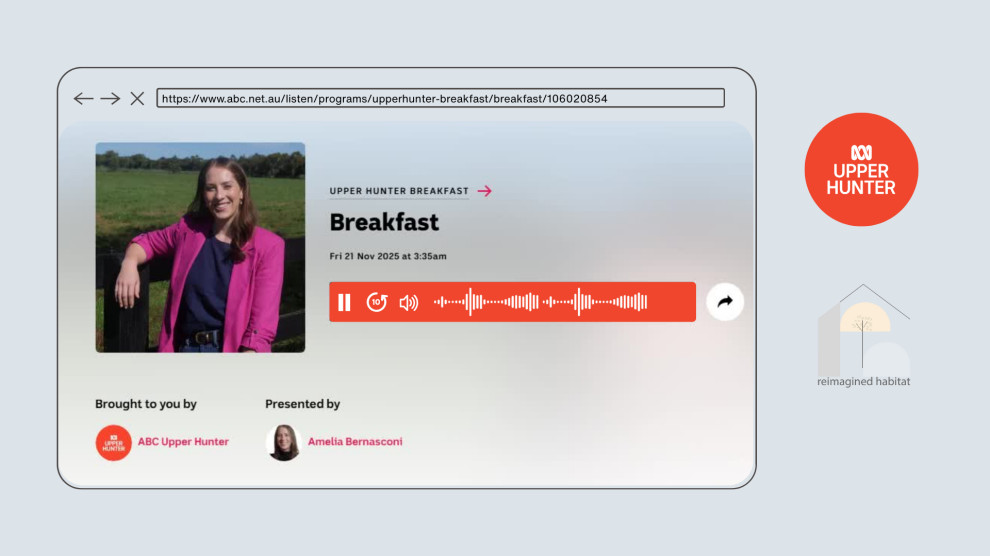
ABC Breakfast Radio – “Save Money, Live Comfortably”
Earlier last week, Michael Drage — founder of reimagined habitat, efficient habitat and net zero plus — joined ABC Upper Hunter Breakfast Radio to talk about high-performance homes and how everyday households can make their homes more efficient, more comfortable, and more affordable to run.
The conversation was part of promoting the upcoming free webinar “Save Money, Live Comfortably – The Sustainable Home Forum”, delivered by Upper Hunter Shire Council and open to the public Australia-wide.
What is Passive House?
Michael explained the difference between:
Passive solar design – using sun, light, shading and orientation to heat and cool a home naturally.
Passive House (Passivhaus) – a German building standard focused on ultra-low energy use, airtightness, insulation and high-performance windows.
While Grand Designs often glamourises Passive House projects, Michael emphasised that the core principles are simply building physics — not hype — and that these principles can be applied to any home, new or old.
Why do Australian homes perform so poorly?
Michael highlighted a key issue: The average Australian home changes its entire volume of air 15–20 times per hour — far more than people realise. This uncontrolled leakage means we’re constantly re-heating or re-cooling the entire house, sending energy bills through the roof.
New homes aren’t immune, either. Recent testing in Canberra found air change rates of 23–26 times per hour in brand-new builds. Contrast that with Passive House buildings at 0.6 air changes per hour, and it becomes clear why airtightness matters so much.
Where do most homes lose energy?
Two places, overwhelmingly:
- Airtightness (drafts, gaps, uncontrolled air leakage)
- Windows — especially poorly performing single glazing or aluminium frames with no thermal break
Michael explained that even in brand-new homes with insulated walls, windows often perform 12 times worse than the surrounding construction. That’s why better glazing can make a dramatic difference, and why “double glazing” alone is not enough — performance varies hugely.
What can homeowners and renters do right now?
Michael kept the advice simple and practical:
- Seal gaps around doors and windows (cheap, high-impact)
- Use external shading to block summer sun before it hits the glass
- Open windows strategically for ventilation when needed
- Consider incremental upgrades, like smart blinds or DIY shading options
For those building or renovating, think about air leakage, insulation, and better windows from the start.
Is stuffiness a problem in more airtight homes?
Only if airtightness drops below a certain threshold. Most older Australian homes will never get close to that point without major upgrades.
Newer airtight homes simply need controlled ventilation. Once air-tightness reaches about 5.0 air changes per hour, you will need some form of mechanical ventilation.
The webinar’s goal
Michael emphasised that his session in the Sustainable Home Forum isn’t about selling Passive House — it’s about helping everyday households make meaningful improvements, no matter the budget or construction type. Small changes, like sealing gaps and adding external shading, can make a noticeable difference to both comfort and energy bills.