
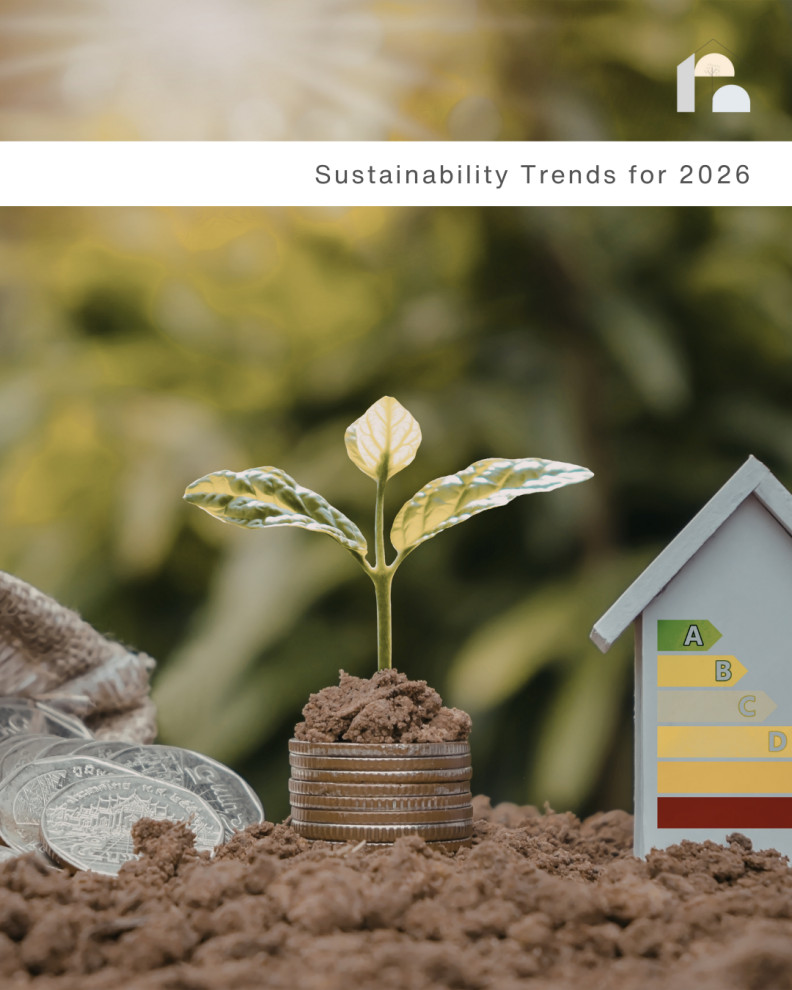
Sustainability Trends for 2026
What’s shaping healthier, smarter homes next year (and beyond)
Sustainability isn’t something we’re waiting for anymore — 2026 is already here, and the shift is well underway.
What we’re seeing right now is a move away from surface-level “green” gestures and towards decisions that genuinely improve how homes perform, feel, and support our health. Clients are asking better questions, builders are lifting their game, and the conversation is becoming far more grounded in building physics, climate resilience, and long-term wellbeing.
This year, sustainability is less about what looks good on paper and more about what actually works in real homes, in real Australian conditions.
Here are three sustainability trends we see defining housing in 2026 — not as future ideas, but as changes already happening on the ground.
Trend 1: Fresh, Filtered & Healthy Air (Finally Getting the Attention It Deserves)
For years, energy efficiency stole the spotlight. In 2026, air quality steps firmly into centre stage.
People are starting to ask better questions:
- Why does my home feel stuffy in summer?
- Why does smoke still get inside during bushfires?
- Why do we wake up tired even when the temperature is “right”?
The answer often comes back to ventilation — or the lack of it.
Enter: HRV / MVHR systems
(Heat Recovery Ventilation or Mechanical Ventilation with Heat Recovery)
These systems:
- Continuously supply fresh, filtered air
- Remove stale air, moisture, and pollutants
- Recover energy from the outgoing air so comfort isn’t compromised
In summer, this becomes especially powerful. A well-designed HRV system can:
- Ventilate without simply dumping hot outdoor air inside
- Filter smoke and particulates during bushfire events
- Support night purging strategies when conditions allow
This is why Passive House principles place such a strong emphasis on ventilation. Airtightness without ventilation doesn’t work — but airtightness with controlled, filtered fresh air creates homes that feel calm, consistent, and genuinely healthy.
In 2026, we expect filtered fresh air to be seen not as a “premium upgrade”, but as a basic health requirement.
Trend 2: Responsible Materials (Not Just What Looks Good, But What Is Good)
Sustainability conversations are moving beyond “what’s the finish?” to “where did this come from — and what’s it costing the planet?”
In 2026, material choices are becoming:
- More transparent
- More data-driven
- More values-led
We’re seeing increased interest in:
- Low-carbon materials
- Products with verified environmental data
- Responsibly sourced timber and finishes
- Materials with low VOCs and reduced off-gassing
- Products designed to last — not be replaced in five years
This is where platforms like Evitat are incredibly valuable. They allow designers, builders, and homeowners to:
- Compare environmental and health properties
- Understand embodied carbon impacts
- Make informed choices instead of assumptions
Responsible material selection isn’t about perfection.
It’s about making better decisions, more often, and understanding the trade-offs.
In 2026, sustainability is less about being “eco” — and more about being accountable.
Trend 3: Performance Over Size (Smaller, Smarter, More Comfortable Homes)
This one’s been building quietly — and now it’s impossible to ignore.
As construction costs rise and climate extremes intensify, people are realising that:
- Bigger homes aren’t necessarily better homes
- Excess space often means excess cost, energy use, and stress
- Comfort comes from performance, not floor area
In 2026, we expect to see:
- More compact, well-planned homes
- Smarter zoning and multi-functional spaces
- Fewer “bling” inclusions, more investment in the building envelope
- A stronger focus on insulation, airtightness, shading, and thermal performance
This aligns closely with Passive House thinking — not because every home needs certification, but because the building physics works.
A smaller home that:
- Holds its temperature
- Has fresh, filtered air
- Avoids condensation and mould
- Costs very little to heat or cool
…will always outperform a larger home built to minimum standards.
And importantly, it’s more affordable to build and to live in.
What This Means for 2026 (and for You)
Sustainability in 2026 is:
- More human
- More evidence-based
- Less about trends for the sake of trends
Healthy air, responsible materials, and high-performing homes aren’t separate ideas — they’re deeply connected.
At reimagined habitat, this is exactly where our work sits:
designing homes that feel good to live in, perform predictably, and support long-term wellbeing — without unnecessary complexity.
Because comfort isn’t a mystery.
It’s the outcome of good decisions, made early.