
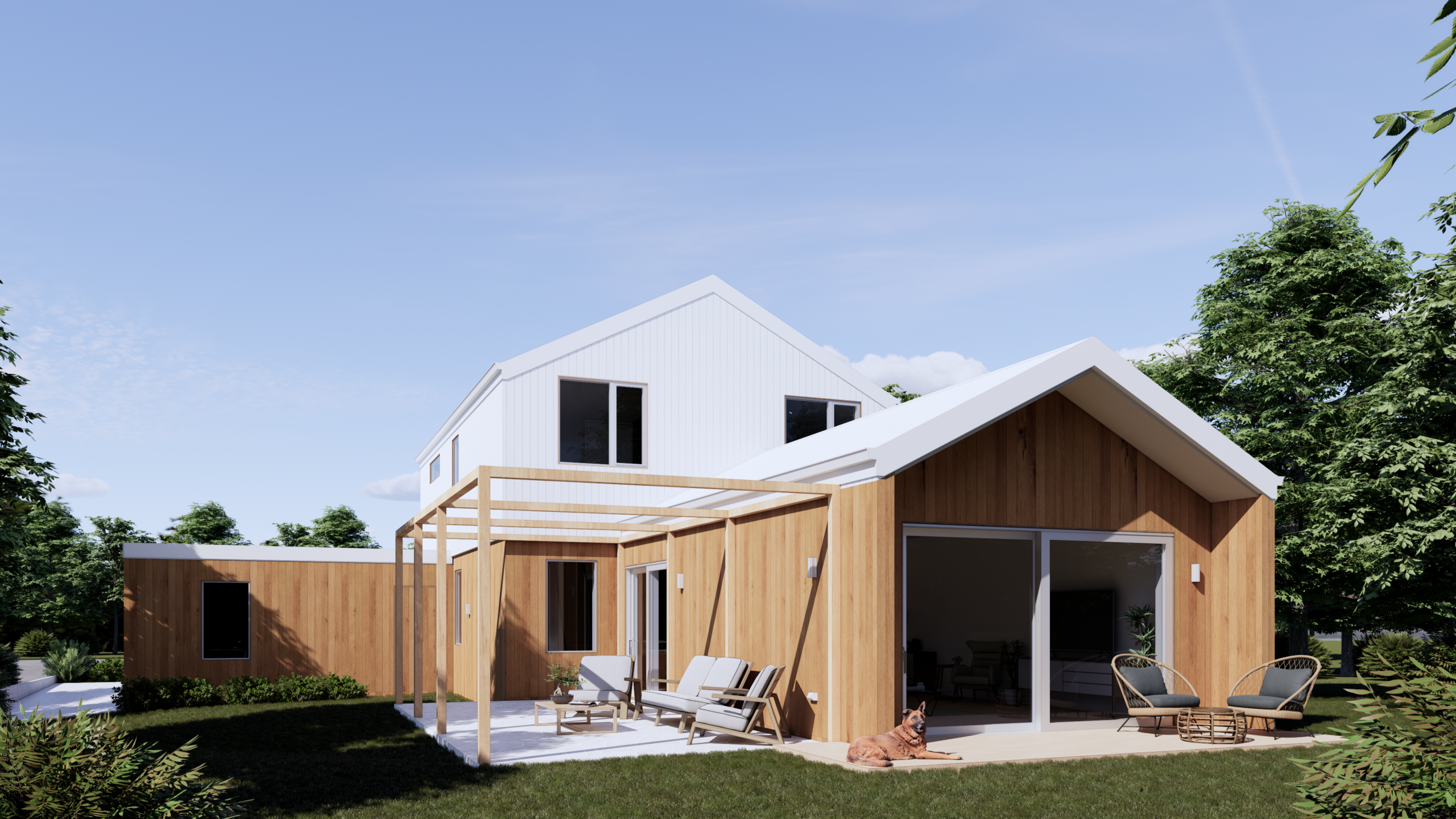
The cost to build a passive house in Australia varies significantly depending on the size, complexity, location, builder, and level of performance you are trying to achieve
It’s one of the most common questions we are asked — and understandably so.
At reimagined habitat, we regularly speak with homeowners who are interested in building a Passivhaus or high-performance home, but who are unsure whether it is financially achievable. The challenge is that there is no single universal answer. Costs vary enormously depending on what type of home you are comparing it to, the complexity of the design, the builder involved, the level of specification, and the approach taken to the project from the beginning.
There is also still a great deal of confusion within the building industry itself. Ask different people and you will often receive very different answers. Some compare Passive House to entry-level volume-built housing, while others compare it to custom-designed architecturally detailed homes with premium specifications. Naturally, the numbers can vary dramatically.
Before diving further into costs, it’s important to step back and look at what has happened across the Australian construction industry over recent years — because the broader market has changed significantly.
If you are new to Passive House and want to better understand the standard itself, you may also enjoy reading: What Is Passivhaus — And Why Do We Love It So Much?
The Big Question
The burning question: how much does it presently cost to construct a PassivHaus or a high-performing home?
Regrettably, there’s no simple or definitive answer. Discussing budgets within the industry can still feel surprisingly taboo. Nobody wants to inadvertently create unrealistic expectations, particularly in a market where pricing continues to fluctuate significantly depending on builder availability, project complexity, material selections, site conditions, and location.
There are also major differences between:
- a minimum-code home
- a thoughtfully designed passive solar home
- a high-performance home
- and a certified Passive House
These are not equal comparisons.
General Comparisons
There are some broader questions we hear regularly:
Does a passive house cost more than building a normal home?
Yes and no. It depends entirely on what you compare it to.
Does it cost more than a home from a volume builder?
Generally yes. But any well-designed custom home will typically cost more than a basic volume builder product.
Does it cost more than a highly energy-efficient home following passive solar design principles?
Sometimes yes, sometimes no. There are overlaps between the two approaches, which we will discuss further below.
Does it cost more than a custom-designed home with a high-end builder?
Not necessarily.
Even within the industry, many professionals continue debating these questions. For us, the more important challenge is this:
How do we make healthier, higher-performing homes more accessible and more affordable over time?
That question sits at the core of much of our work.
What Are You Actually Paying For?
One of the biggest misconceptions around Passive House is that people assume they are simply paying more money for “extra insulation”.
But a well-designed Passive House delivers far more than lower energy bills.
You are also investing in:
- dramatically improved thermal comfort
- healthier indoor air quality
- reduced condensation and mould risk
- quieter internal environments
- improved resilience during heatwaves and cold weather
- reduced running costs over the long term
- more stable internal temperatures year-round
In Australia, many homes still suffer from:
- draughts
- overheating
- cold internal surfaces
- poor insulation
- condensation
- mould
- poor indoor air quality
We often accept these issues as “normal”, but they are actually symptoms of poorly performing building envelopes.
Passive House takes a fundamentally different approach.
If health and indoor air quality are important to you, you may also enjoy: Healthy Homes: Why Passive House is About So Much More Than Just Energy
Looking Back: 2018–2021
In 2018 and 2019, the prevailing belief within the industry was that building a Passive House would cost no less than $3500 per square metre. Some builders would not even consider taking on a project for less than $5000 per square metre during that period.
However, our own projects challenged many of these assumptions.
We successfully completed several Passive House projects with contracts signed between 2018 and 2019, and their final build costs ranged between approximately $2500 and $3000 per square metre.
Yes — these homes were actually built and delivered.
In contrast, homes with contracts signed during 2020 and early 2021 were generally constructed at costs ranging between $3000 and $3500 per square metre.
These projects often featured:
- straightforward forms
- simple roof designs
- flat ceilings
- compact and efficient layouts
- careful detailing
All of these decisions helped create more economical Passive House outcomes compared to highly complex custom homes.
This is an important point:
Good performance does not require unnecessary complexity.
Thoughtful design decisions can significantly reduce costs.
2024–2026: The Cost Surge
Over recent years, the Australian construction industry has experienced enormous pressure.
Build costs have risen sharply due to:
- labour shortages
- material cost increases
- supply chain disruptions
- builder insolvencies
- insurance increases
- energy price rises
- higher financing costs
At the same time, expectations around sustainability, condensation management, energy efficiency, and climate resilience have continued increasing.
This has impacted all forms of construction — not just Passive House.
In many cases, the gap between:
- a well-built custom home
- and a Passive House
has actually become smaller than it once was.
Passive House vs Passive Solar Design
This is another area where confusion often arises.
Passive solar design and Passive House principles are not the same thing — although they can absolutely work together.
Passive solar design typically focuses on:
- orientation
- glazing placement
- thermal mass
- shading
- solar access
Passive House goes further by incorporating:
- rigorous energy modelling
- airtightness targets
- thermal bridge reduction
- continuous insulation
- high-performance windows
- mechanical ventilation with heat recovery
Both approaches can create excellent homes when done properly.
However, Passive House provides measurable performance targets and verification processes that remove much of the guesswork.
You can read more here: Passive Solar Design vs. Passivhaus: What’s the Difference?
Why Simplicity Matters
One of the biggest opportunities for improving affordability lies in simplifying design and construction.
Complex homes tend to cost more because they often involve:
- complicated roof forms
- difficult junctions
- excessive articulation
- structural complexity
- more labour
- more detailing
- more potential for thermal bridging and air leakage
Simple forms generally:
- perform better
- cost less
- are easier to build
- are easier to make airtight
This is one reason we are so passionate about prefabrication and panelised construction systems through our collaboration with net zero plus and the development of our net zero habitat range.
You can explore more here: Already Have Plans? Here’s Why Prefab Could Be Your Best Move
and
Unpacking the Myths About Prefab Homes
Can Passive House Become More Affordable?
We genuinely believe it can.
As supply chains improve, industry knowledge grows, and more builders gain experience with:
- airtightness
- thermal bridge-free detailing
- high-performance windows
- ventilation systems
- prefabrication
the cost premium associated with Passive House can continue reducing.
This has already happened internationally.
We are also seeing growing policy recognition across Australia.
Recently, the ACT officially recognised Passivhaus as a compliance pathway — an important step forward for the industry: ACT Recognises Passivhaus as an Official Compliance Pathway
The Long-Term Perspective
When discussing build costs, it is also important to look beyond upfront construction pricing.
A high-performance home may:
- reduce operational energy costs for decades
- improve comfort and wellbeing
- reduce maintenance risks associated with condensation and moisture
- increase resilience during heatwaves
- improve acoustic comfort
- create healthier living conditions
These benefits are difficult to quantify purely through dollars per square metre.
Increasingly, we are seeing homeowners place greater value on:
- comfort
- health
- resilience
- energy security
- and long-term performance
rather than simply chasing the cheapest possible upfront build cost.
Final Thoughts
There is no single fixed answer to the question:
“How much does it cost to build a passive house?”
The reality is far more nuanced.
The cost depends on:
- your site
- your goals
- your builder
- your level of performance
- your design complexity
- your specification selections
- and the way the project is approached from the beginning
But what we can say with confidence is this:
Thoughtful design, early planning, realistic budgeting, and performance-led decision making can dramatically improve both affordability and outcomes.
At reimagined habitat, we are deeply passionate about helping create homes that are:
- healthier
- more comfortable
- lower energy
- climate resilient
- and designed for long-term liveability
Because ultimately, we believe homes should do far more than simply shelter us.
They should actively support better living.
Frequently Asked Questions
Is a Passive House more expensive to build?
Often yes compared to minimum-code housing, but not necessarily compared to well-designed custom homes.
Can a Passive House save money long term?
Yes. Reduced heating and cooling demand can significantly lower operational energy costs over time.
What is the cheapest way to build a Passive House?
Simple forms, efficient layouts, thoughtful detailing, and early performance modelling are key.
Does airtightness increase build cost?
It can initially, particularly where builders are unfamiliar with the process. However, industry experience continues improving.
Are high-performance windows worth it?
Absolutely. Windows are one of the most critical components of comfort, condensation management, and overall thermal performance.
You can read more here: What Are the Best Windows for a High-Performing Home or Passive House?