
Can A New Delivery Model Unlock Australia's Missing Middle
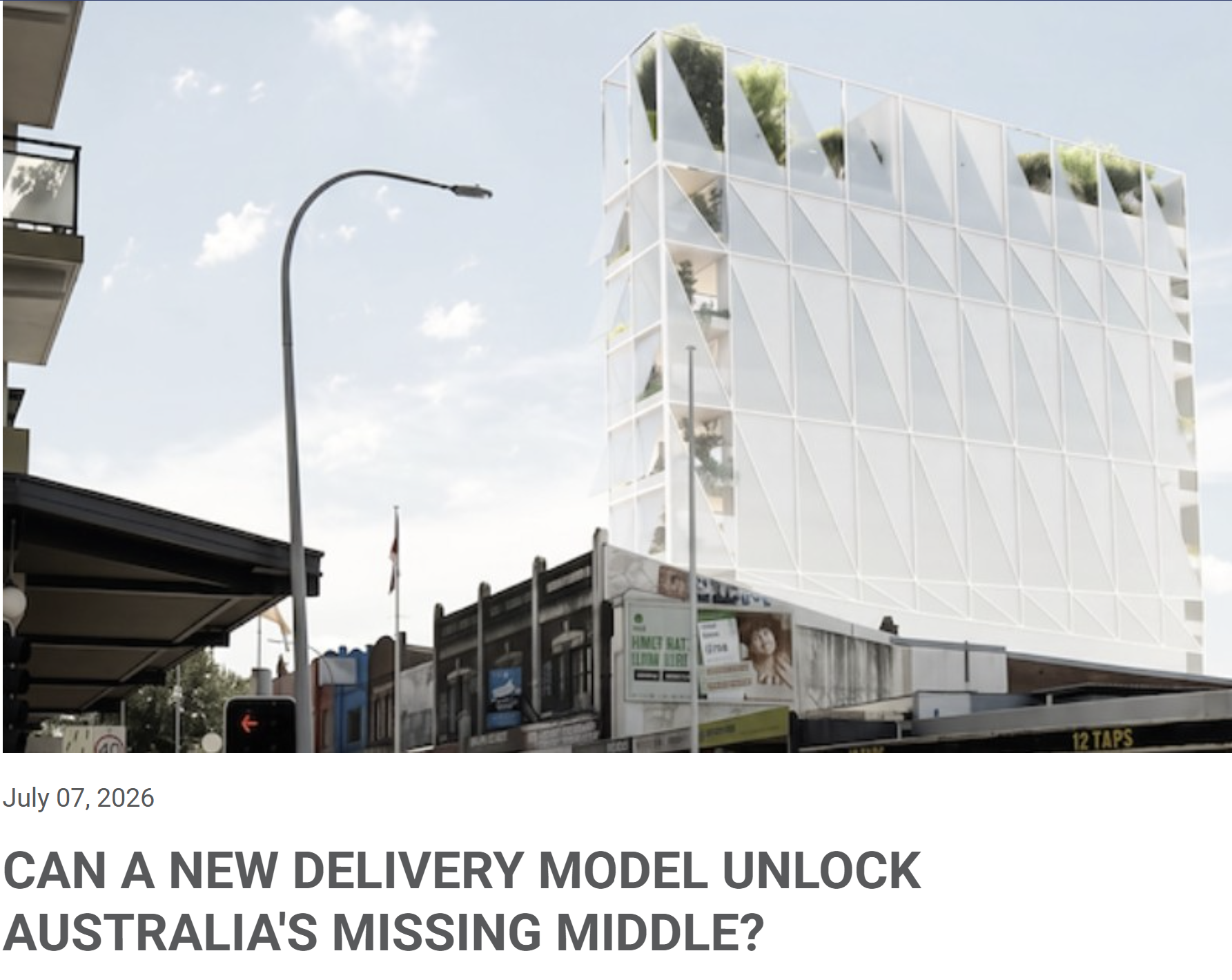
We’re thrilled to see Michael Drage featured again in Built Offsite — this time in part two of a two-part interview exploring one of the most important questions in Australian housing right now: how do we actually deliver missing middle housing.
It’s a fantastic piece, and we couldn’t be prouder to see Michael’s thinking given the platform it deserves. If you care about where high-performance, medium-density housing in Australia is heading, it’s well worth your time.
Uncommon Living And The Missing Middle Housing Challenge
The interview digs into Michael’s latest venture, Uncommon Living — the Sydney and Canberra-based business he’s building to tackle the missing middle: the medium-density housing that sits between detached suburban homes and high-rise towers, and which Australia has struggled to deliver well.
The central idea is that better buildings alone won’t solve our housing challenges. As Michael puts it:
“We’re aiming at a new delivery model.”
Rather than approaching a project as either architects or builders, Uncommon Living integrates planning, architecture, finance and offsite construction into a single process — making the commercial and design decisions together, before construction methods are locked in.
The points that resonated most with us
A few threads in the interview go right to the heart of what we believe too:
- It’s a delivery-model problem, not just a building problem. Michael’s work on building performance led him to a bigger question: if the construction process itself introduces uncertainty, why not rethink the whole way projects are conceived and delivered?
- The team is the product, not a proprietary system. Unlike many offsite businesses, Uncommon Living isn’t built around one factory or one building system. It assembles the right team, methodology and pathway for each site. The starting point is “never the product itself” — it’s the planning controls, site constraints, commercial goals and performance targets, with the construction solution chosen to suit.
- Timber and prefab where it fits. Where a site allows, projects can use prefabricated timber systems through Michael’s related business, Net Zero Plus. “Our preference is timber,” he says, “but if the site doesn’t allow for that, then we’ll look at how we can do it otherwise.”
- Performance is the benchmark — with pragmatism. Passive House principles still underpin the thinking, but certification isn’t the goal for its own sake. “We’ll go to Passive House where we can. If we can’t, we can’t. We’ve got to be pragmatic about it.” What stays constant is the technical rigour — blower-door testing, thermal bridge analysis and post-construction verification — because those confirm a building actually performs as intended.
- Developers buy certainty. Michael’s finance background shapes everything: start with commercial viability, reduce uncertainty at every step. “They buy certainty,” he says — and that certainty comes from combining planning, feasibility, design rigour and performance into one process.
The line we loved most
Perhaps the most generous idea in the whole piece is Michael’s ambition to share the model rather than hoard it:
“We want to open-source this to a degree. We don’t have to own the market. To me, that’s crazy. If we can help the industry lift and show others how to do this, then that’s a massive win.”
That mindset — lifting the whole industry rather than protecting a patch — is exactly the spirit we try to bring to our own work. Better homes for more Australians will only happen if good ideas spread.
Read the full interview
We’ve only skimmed the highlights here. The full article covers the Uncommon Living team, the Marrickville developments, the role of verification, and where the conversations are heading next (Sydney, with early discussions in Melbourne, Adelaide and Brisbane):
→ Can a new delivery model unlock Australia’s missing middle? — Built Offsite
Huge congratulations to Michael on the feature — and to Built Offsite for shining a light on the kind of thinking our housing sector needs more of. If it sparks questions about high-performance, medium-density housing, we’d love to talk.