
From Rice Fields to the World Stage: Celebrating Juven's Presentation at the World Sustainable Built Environment Conference 2026
Sustainable building research has an important role to play in solving some of the biggest challenges facing housing, energy use and climate resilience around the world.
This sustainable building research project explored how agricultural waste from rice production could be transformed into a building material capable of improving thermal comfort and reducing energy demand in homes throughout the Philippines.
At reimagined habitat, we are incredibly proud of our very own rocket scientist Juven.
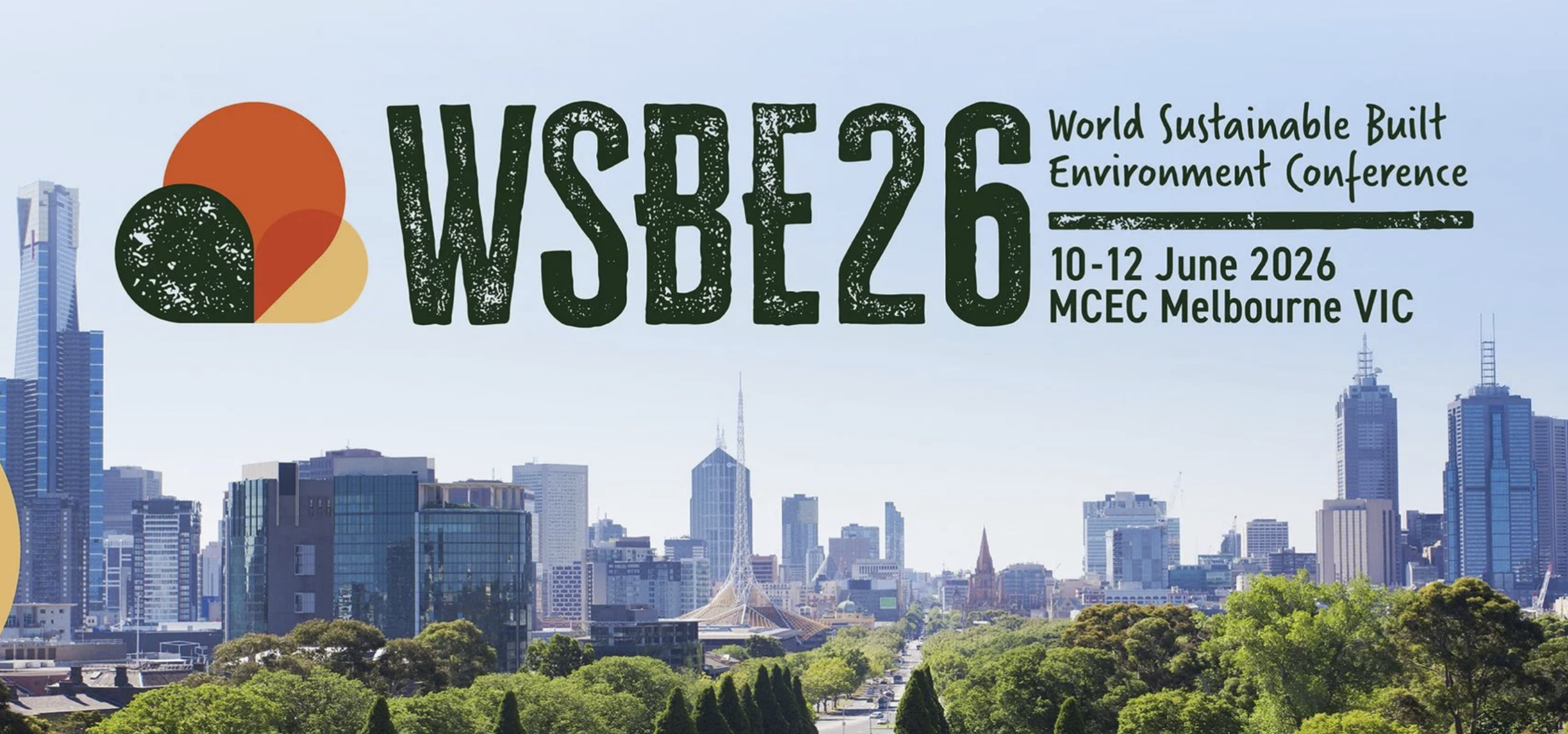
This week, Juven had the honour of presenting his research at the World Sustainable Built Environment Conference 2026 (WSBE26) in Melbourne — one of the most prestigious sustainability and building science conferences in the world.
While Juven was the lead researcher and presenter, the project was also supported by our team members Aliah and Roma, who assisted throughout the research process and contributed to the development of the study.
For those unfamiliar with WSBE, this is not just another industry event.
The World Sustainable Built Environment Conference brings together leading researchers, academics, policymakers, engineers, architects and sustainability professionals from around the globe to share the latest research and innovations shaping the future of our built environment.
The calibre of speakers and presenters is extraordinary.
These are the people influencing international policy, advancing building science, developing new technologies and helping define what sustainable buildings will look like for future generations.
To be selected to present at such a conference is a significant achievement.
For a young researcher and building scientist, it represents recognition from the international academic community that your work contributes meaningfully to solving real-world challenges.
And that’s exactly what Juven’s research does.
Tackling Two Challenges With One Solution
The research formed part of Juven’s Master’s thesis and was developed with the support of Aliah and Roma from the reimagined habitat team. Together, they explored how local materials and building science principles could be combined to improve comfort, sustainability and resilience in Philippine housing.
Juven’s research explored a fascinating question:
Could agricultural waste from rice production be transformed into a building material that improves thermal comfort and energy performance in homes?
The research focused on the Philippines, where core-filled concrete hollow blocks (CHBs) remain one of the most common walling materials used in residential construction.
While widely available and relatively inexpensive, these blocks come with challenges.
Like many masonry-based construction systems, they can absorb and store significant amounts of heat, contributing to overheating inside homes.
As temperatures continue to rise across the Philippines due to climate change, overheating is becoming an increasingly serious concern.
Many homes struggle to maintain comfortable indoor temperatures, leading to greater reliance on mechanical cooling systems and higher energy consumption.
At the same time, the Philippines faces another challenge.
As one of the world’s major rice-producing nations, it generates enormous quantities of agricultural by-products, including rice husks.
Much of this waste is disposed of through dumping or other waste streams, creating environmental concerns and missed opportunities for resource recovery.
Juven’s research asked an important question:
Could rice husk ash (RHA) become part of the solution?
Turning Waste Into Opportunity
Rice husk ash is produced from rice husks, a by-product of rice farming.
Previous research has suggested that incorporating rice husk ash into masonry products may improve their thermal properties while simultaneously creating a productive use for agricultural waste.
Rather than viewing rice husks as a disposal problem, they could potentially become part of a more sustainable building solution.
This concept aligns perfectly with the principles of a circular economy, where waste materials are repurposed into valuable resources rather than ending up in landfill.
But theory alone is not enough.
The critical question remained:
Would these alternative masonry units actually improve building performance?
Using Passive House Tools to Evaluate Local Solutions
To answer that question, Juven utilised the Passive House Planning Package (PHPP).
While PHPP is most commonly associated with Passive House certification projects, it is also one of the most sophisticated building performance modelling tools available.
PHPP allows researchers and designers to evaluate how different building assemblies, materials and systems influence energy demand, thermal comfort and overall building performance.
Using PHPP, Juven compared the thermal performance of conventional core-filled concrete hollow block construction against masonry units incorporating rice husk ash.
The goal was not simply to achieve Passive House certification.
Instead, the objective was to use robust building science tools to better understand how local material choices can influence thermal comfort and energy use within a Philippine context.
This is an important distinction.
One of the strengths of Passive House methodology is that its principles can be applied well beyond certified projects.
The building physics remain the same whether a project is located in Germany, Australia, the Philippines or anywhere else in the world.
Good modelling allows us to make informed decisions based on evidence rather than assumptions.
Why This Research Matters
What makes Juven’s research particularly exciting is that it sits at the intersection of several critical global challenges.
It explores:
- thermal comfort
- energy efficiency
- climate resilience
- circular economy principles
- waste reduction
- sustainable material innovation
all within a single research project.
As our industry works to reduce emissions and improve building performance, we need solutions that are practical, scalable and locally relevant.
The answer will not always come from importing expensive technologies or complex systems.
Sometimes the most impactful innovations come from rethinking materials and resources that already exist within local communities.
Rice husk ash masonry units may represent one such opportunity.
While further research is still required to evaluate structural performance, manufacturing feasibility and broader environmental impacts, the potential is exciting.
Building Science Without Borders
One of the things we love most about Juven’s work is that it demonstrates how building science can be applied globally while remaining deeply connected to local contexts.
At reimagined habitat, we often talk about the importance of designing climate-responsive, healthy and high-performing homes.
That doesn’t mean every country should build exactly the same way.
It means understanding the local climate, local materials, local resources and local challenges, then applying sound building science principles to create better outcomes.
Juven’s research embodies exactly that approach.
Rather than simply replicating solutions from elsewhere, it investigates how local materials can be leveraged to improve performance in a way that makes sense for the Philippines.
A Proud Moment For Our Team
For us, this achievement is about much more than a conference presentation.
It’s about seeing one of our team members contribute to a global conversation about the future of sustainable buildings.
It’s about recognising the value of curiosity, research and lifelong learning.
And it’s about demonstrating that innovative thinking can emerge from anywhere.
To stand alongside world-renowned researchers and sustainability experts at an event like WSBE26 is an incredible accomplishment.
To present your own research on that stage is something truly special.
We couldn’t be prouder of Juven, Aliah and Roma, and the contribution they have made to this important research. Seeing Juven present their work on the world stage was a proud moment for our entire team.
Congratulations to all three of you on this outstanding achievement.
We can’t wait to see where your journey takes you next.