
How Much Can a Passive House Really Save You on Energy Bills? (And When Does It Pay for Itself?)
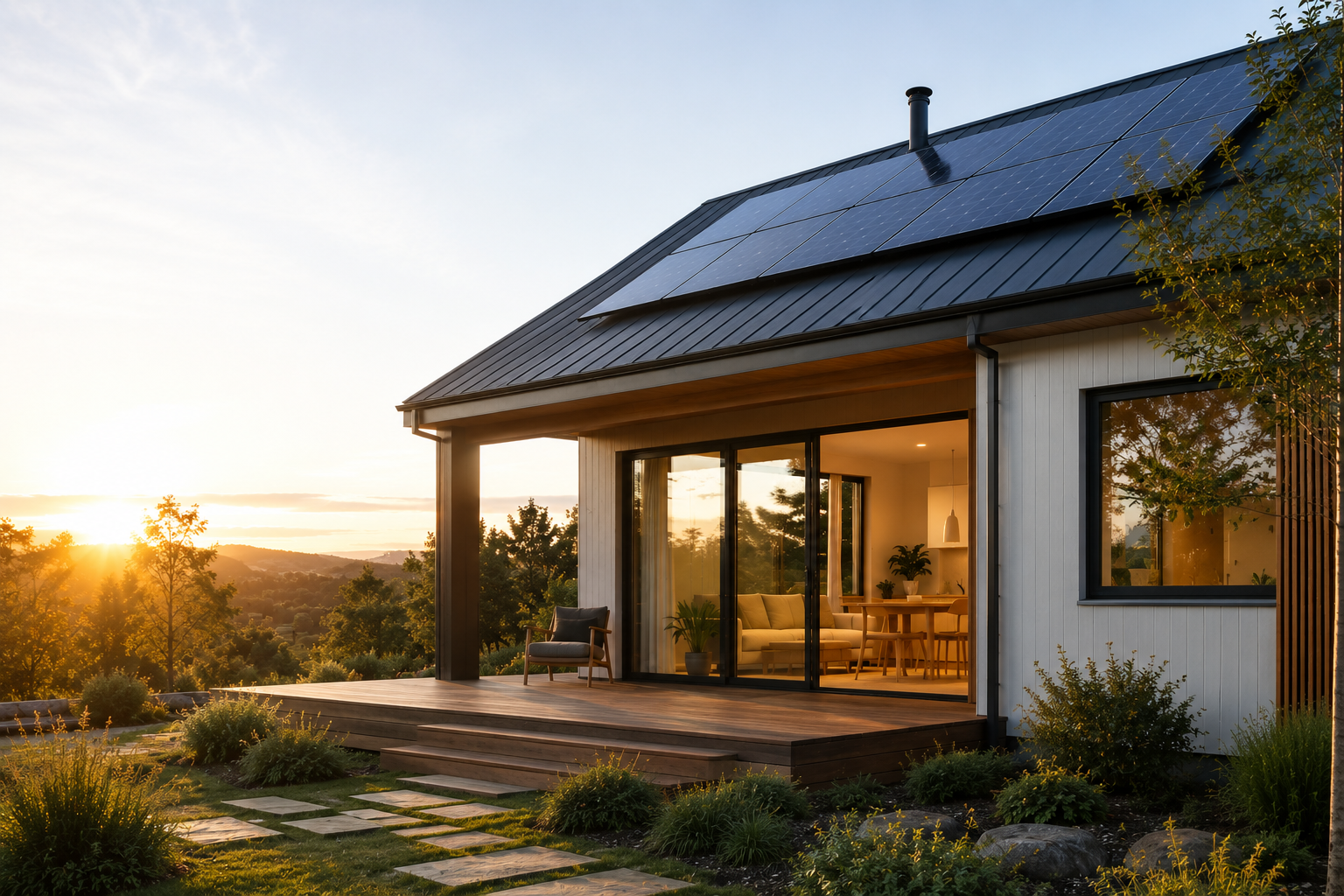
Whenever we sit down with someone thinking about a passive house, two questions come up before almost anything else: How much will it actually save me on my power bills? And how long until that pays me back?
They’re fair questions. A home is the biggest purchase most of us ever make, and “it’ll be more comfortable” doesn’t pay the mortgage. So let’s talk about the money honestly — the savings that are real, the numbers we can stand behind, and why the payback question, while reasonable, isn’t quite the right one to be asking.
Where your energy money actually goes
Here’s the part most people don’t realise. In a typical Australian home, heating and cooling alone account for around 40% of energy use, and on a lot of bills it’s closer to half. We spend that money fighting our own houses — pumping heat in through winter, dragging it back out through summer, because the building itself does almost nothing to hold a comfortable temperature.
A passive house flips that. By getting the building envelope right — proper insulation, genuine airtightness, high-performance windows and heat recovery ventilation — the home holds its temperature on its own. The result is that the single biggest line item on your energy bill gets cut down to almost nothing.
That’s the whole game. We’re not bolting on gadgets to use energy more cleverly. We’re designing a house that barely needs the energy in the first place.
The savings, in real numbers
Internationally, passive houses are designed to cut heating and cooling energy by up to 90% compared to standard buildings. That figure holds up here too, with one important caveat: how much you save depends on what you’re comparing against.
If you’re replacing an old, draughty, uninsulated home — the weatherboard classic, or a brick-veneer place from the 70s — the difference is dramatic. There’s a well-documented retrofit of a 1910 weatherboard home in Melbourne that ended up costing about $450 a year to run for all its heating, cooling and appliances combined, after a roughly 95% cut in heating and cooling costs. For a house of that age, that’s almost hard to believe.
If you’re comparing against a brand-new home built to today’s 7-star standard, the gap is smaller but still meaningful — a well-built passive house can use a fraction of the heating and cooling energy of a code-minimum new build.
To put rough numbers on it: the average Australian household electricity bill sits around $1,424 a year, and heating and cooling is a big chunk of that. In a true passive house, that chunk largely disappears. Add rooftop solar — which pairs beautifully with a low-demand home, because a small system can cover a much larger share of your needs — and many of our clients are looking at near-zero net energy bills. Not “20% off.” Near zero.
A few honest caveats, because we’d rather you trust us than oversell you:
- Your savings depend on your climate, your old home, your habits and how you actually live in the space.
- Electricity prices move. At current rates of roughly 30–35 cents per kWh, the savings are real and they tend to grow as energy gets more expensive — which is its own quiet form of protection.
- The biggest savings come from getting the fundamentals right, not from any single product. Building “to passive house principles” without the rigour behind it often leaves a lot of those savings on the table.
So what does it cost upfront?
This is where the payback maths starts, so let’s be clear-eyed about it. You’ll see figures all over the place — anywhere from 10–20% more than a standard build, down to almost no premium at all.
Both can be true, and the difference is design. A passive house bolted onto a floor plan that was never meant for it gets expensive fast. A home designed from the first sketch around how it performs — orientation, form, glazing, the works — can land remarkably close to a conventional build, and in warmer parts of Australia the premium can be as low as 0–3%. We’ve written more on this in how much it actually costs to build a passive house and in our true-cost comparison of high-performing versus standard homes.
When does it pay for itself?
If you take the extra cost and divide it by your annual savings, you’ll usually land somewhere in the 3 to 7 year range for the energy premium to pay itself back. On a modest premium with solid savings, it can be faster. On a poorly designed build, a lot slower — and this is the part we want to be completely straight with you about.
What if the premium is actually 20–30%?
It happens. We’ve seen builds where the passive house cost premium isn’t 3% or 10% but 20–30%. Almost always, the reason is the same: the home wasn’t designed as a passive house from the start. The floor plan, orientation, form and glazing were locked in first, and passive house performance was bolted on afterwards — which means oversized triple glazing to fix a poorly oriented wall of windows, extra structure to handle thermal bridges that good design would have avoided, and detailing that fights the building instead of working with it.
Let’s do the honest maths on that. Take a $700,000 build. A 25% premium is $175,000. If that home saves you, say, $2,500 a year on energy compared with a standard new build, the energy-only payback is around 70 years — longer than you’ll likely own the house.
That number looks alarming, and it should — but read it correctly. It isn’t telling you “passive house doesn’t pay off.” It’s telling you that a 20–30% premium is the price of doing it late or doing it wrong, not the price of passive house done well. The exact same performance, designed in from the first sketch, routinely comes in at a fraction of that premium — sometimes close to zero in our warmer climates — which is what pulls the payback back into the single-digit years. The cost blowout lives in the design process, not in the standard itself. It’s the single biggest reason we push so hard to be involved before the plans are set.
So if a builder quotes you a 25% premium to “make it passive house,” that’s not a reason to abandon the idea. It’s a sign the design needs rethinking from the ground up — and a conversation worth having before you commit.
But here’s the thing we tell everyone: payback is the wrong way to think about this.
We don’t ask what the payback period is on a nicer kitchen, a second bathroom, or higher ceilings. Those are things we buy because they make the home better to live in, and we accept the cost. A passive house is unusual because it’s one of the few “nicer home” decisions that also hands money back every single year — but if you reduce it to a payback spreadsheet, you miss most of what you’re actually buying.
What you’re buying is a home that’s the same comfortable temperature in every room, all year. Air that’s continuously filtered and fresh, which matters enormously for anyone in the household with asthma, allergies or sensitivity to mould. A house that’s quiet. A house that doesn’t lurch from freezing to stifling when the weather turns. And yes, a house that’s far cheaper to run, more resilient as energy prices climb, and worth more when you sell it.
The energy savings are the part you can put in a spreadsheet. They’re real, and over the life of the home they add up to tens of thousands of dollars. But they’re the floor of the value, not the ceiling.
The short version
A well-designed passive house can cut your heating and cooling energy by up to 90%, take a typical home’s running costs down towards near-zero when paired with solar, and pay back its (often modest) cost premium within roughly 3–7 years. After that, the savings are yours for the life of the home — alongside the comfort, the clean air and the quiet that don’t show up on any bill.
If you’d like to see what those numbers could look like for your block and your budget, get in touch. We’ll run the actual figures for your situation rather than the averages — because your home isn’t an average, and neither is your power bill.
The figures in this article are drawn from Australian and international passive house data and are intended as a general guide. Actual savings and costs vary with climate, design, site and energy prices. We’re happy to model your specific project.