
The Unpriced Climate Risk: What It Means for Australian Homes — and How We Can Reduce It
The Unpriced Climate Risk: What It Means for Australian Homes — and How We Can Reduce It
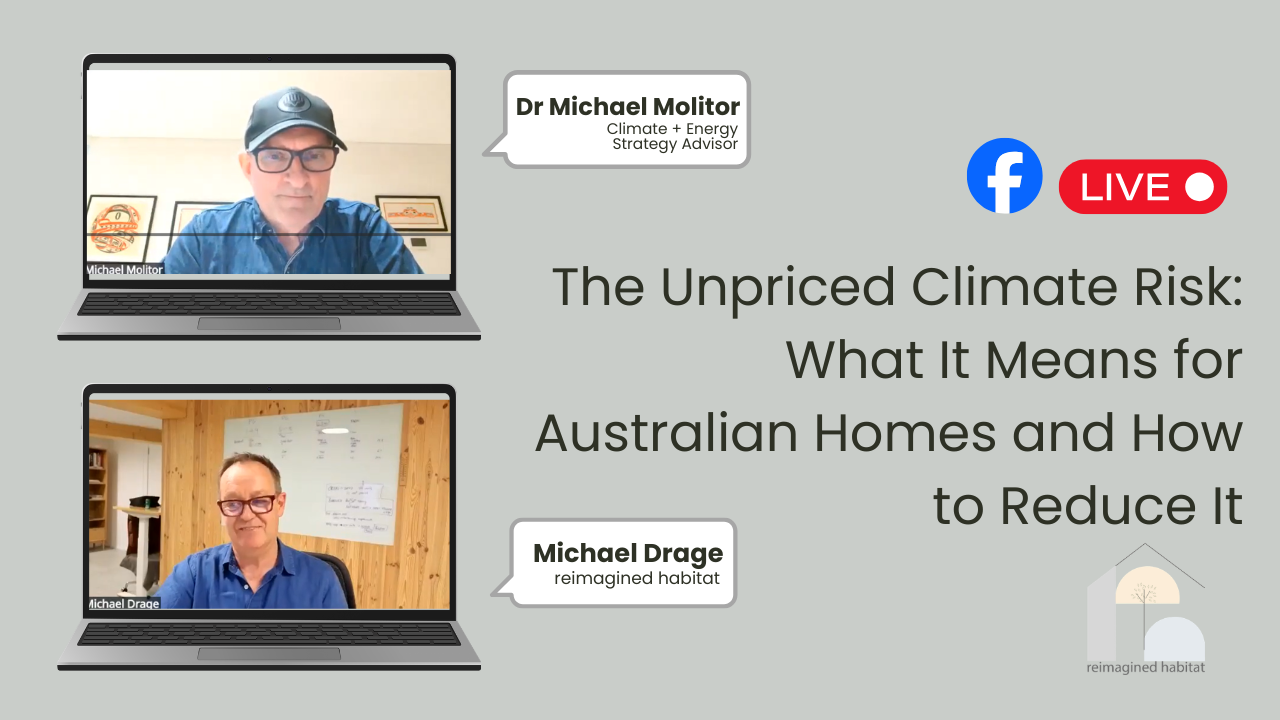
A deep-dive conversation with Dr Michael Molitor and Michael Drage
Climate change and housing are no longer two separate conversations. They are merging — quickly — into one of the most urgent issues facing Australian families, communities, and the national economy.
In our recent live session, we were joined by Dr Michael Molitor, a climate and energy strategy advisor with decades of experience in global climate policy, carbon markets, risk advisory and corporate strategy. Together with Michael Drage from reimagined habitat, we explored the concept of unpriced climate risk — what it means, why it matters, and how the homes we build today can either deepen or dramatically reduce that risk.
This article distils that conversation into a comprehensive deep dive.
Who Is Dr Michael Molitor — and Why His Perspective Matters
Michael’s background gives him a perspective few others have. He’s worked across the University of California Climate Change Program, BP’s global carbon strategy team, PricewaterhouseCoopers as their global climate change lead, McKinsey, and later as part of the UNSW Climate Change Research Centre.
Across these roles, he’s advised governments, global insurers, high-emissions industries, and now climate-tech start-ups.
And crucially — he sees Australia’s residential property market as one of the most exposed, least-prepared sectors in the country.
With $13 trillion in residential property value, housing is the nation’s largest asset class — and also one of the most at risk.
The Global Cost of Climate Inaction — and Why It Matters Here
Michael opened with blunt clarity:
We now live in a world where we haven’t done enough to prevent climate change — and because of that, trillions of dollars of assets around the world are at risk.
To quantify this, organisations like McKinsey estimate that US$64–65 trillion of global asset value is exposed to climate risk.
Australia recently attempted to understand its slice of that number. According to the National Climate Risk Assessment:
$611 billion in residential property value could be lost by 2050
$770 billion by 2090
And this isn’t speculative modelling — it’s based on known climate pathways, insurance data and property exposure.
This is the financial backdrop behind rising premiums, retreating insurers and increasingly volatile weather. And it directly shapes the future affordability, liveability and resilience of Australian homes.
Understanding How Climate Change Fuels Risk
Michael delivered a short explanation of the physics behind climate instability — from CO₂ emissions to atmospheric mixing, ocean absorption and the increased energy in the climate system.
The key point is simple:
It’s not the annual emissions that determine climate risk — it’s the total concentration of greenhouse gases in the atmosphere.
As CO₂ rises (now at 426.4 ppm compared to ~280 ppm pre-industrial), the atmosphere absorbs more heat, increasing the intensity and frequency of extreme weather.
This explains:
2022 Lismore floods
Catastrophic hailstorms in Brisbane
Deadly heatwaves
Worsening bushfires
Hazardous smoke and air pollution
Extreme weather is now a feature, not an anomaly.
Case Study: Northern Rivers & the Lismore Floods
The Northern Rivers Reconstruction Corporation engaged Michael as part of the advisory team after the devastating 2022 floods that destroyed thousands of homes.
His observations were confronting:
Lismore sits inside an ancient volcanic caldera — essentially a giant bowl
It is one of the worst possible locations for a growing town in a warming climate
The state government needed to buy land, relocate homes, and rebuild. But the essential question became:
Where can we safely build future housing to avoid repeating this disaster?
This led to:
Using climate modelling tools to assess land suitability
Mapping flood, fire, heat and wind exposure
Understanding insurance requirements and reinsurer modelling
But an even bigger issue emerged — one that affects every Australian home.
The Silent Forces: Insurance, Reinsurance & Banking
One of the most powerful insights from the session was this:
Reinsurers (like Munich Re) have the best climate modelling in the world — because their survival depends on it.
And they’re acting faster than governments.
In the US, major insurers have already pulled out of:
Texas
Florida
California
Because the financial risk is simply too high.
Australia is next. Premiums are rising sharply, and insurers are signalling that some regions will become uninsurable.
Banks, too, are beginning to respond. Higher risk equals higher interest rates — not just for individual homes, but for entire suburbs.
This is where Michael introduced two critical concepts:
Physical Risk
The direct damage caused by climate events — floods, fires, storms, hail.
Transition Risk
The economic shift as insurers, banks, regulators and markets begin pricing climate risk properly.
Transition risk is often broader — because it affects entire markets, not just high-risk zones.
How Homes Can Reduce Climate Risk — Location + Design
1. Choose Low-Risk Locations
Where we build matters more than ever. Physical risk can’t be eliminated — but it can be dramatically reduced with better site selection.
2. Build Resilient, Energy-Efficient Homes
Resilience measures can mean the difference between total loss and a home that survives intact.
Resilient homes incorporate:
High airtightness
Double or triple glazing
High-performance insulation
Passive solar design
Non-combustible cladding
Managed ventilation
Filtered fresh air
Reliable water storage
Rooftop solar and battery
EV readiness
This is Passive House territory — or a strong step towards it.
3. Resilience Equals Comfort, Health and Savings
Airtight, well-insulated homes:
Stay cool during heatwaves
Stay warm during cold spells
Help reduce asthma and respiratory illness
Keep out smoke and fine particles
Stay habitable during blackouts
Reduce heating and cooling demand
A Canberra example from the session illustrated this clearly. During the 2020 bushfires, a near-Passive House office stayed at 27°C and smoke-free while the outside reached 40°C and the city was blanketed in hazardous air.
Housing Quality, Health and Australia’s Existing Stock
Simone highlighted the reality of existing rental housing — mould, poor insulation, damp, old carpets, dust mites, and unsafe indoor air.
This represents a growing public health issue, especially for children, older people, and those vulnerable to heat or poor air quality.
This creates urgent need for:
Minimum rental standards
Renovation incentives
Upgraded building codes
Support for energy retrofits
Smoke-safe ventilation solutions
Mould-resistant construction
Australia’s current housing stock lags behind global standards — and climate change will widen that gap without action.
Housing Value Is Already Shifting
Multiple indicators show the market is already valuing efficient, resilient homes more highly:
Homes with sustainability upgrades are selling for 9–15% more
In Sydney’s last cycle, the median price uplift was about $130,000
Efficient homes attract significantly more buyer interest
As Michael said:
There is no “green premium”. The real premium now exists for inefficient homes.
The Energy Transition and the Home as a Micro-Power Station
Another key theme was electrification:
Rooftop solar
Home batteries
EV charging
Vehicle-to-grid systems
Induction cooking
Heat pumps
Banks such as Bank Australia are already offering mortgage discounts for energy-efficient upgrades.
International trials show strong financial returns from homes that generate and export power.
This transforms the home from a passive shelter into an active, income-generating asset.
What Homeowners Can Do Today
Michael outlined practical steps homeowners can take:
Improve airtightness and insulation
Upgrade windows
Electrify everything
Add solar and battery
Use non-combustible materials
Install ventilation with filtration
Build smaller, smarter
Australian homes are among the largest per capita globally. Rethinking size could have a major impact.
Prefab, Panelised Construction and Why It Matters
Prefab and panelised construction were highlighted as key to the future:
Higher quality
Lower waste
Faster build times
Greater precision
Better airtightness
Consistent performance
Australia is behind global leaders, but the shift is inevitable.
Capital Markets Will Force the Tipping Point
Perhaps the most important insight:
Governments will not drive this transition. Capital markets will.
As reinsurers and banks begin pricing risk accurately, we will see shifts in:
Insurance eligibility
Mortgage rates
Home valuations
Building standards
Rental requirements
Planning decisions
Mandatory climate risk reporting begins soon. Once risks are disclosed, markets will respond quickly.
This marks the beginning of the end for business as usual.
The Future: Homes That Make Money, Not Problems
The next generation of homes will:
Cost less to run
Cost less to insure
Qualify for cheaper finance
Stay safe during extreme weather
Generate their own energy
Increase long-term value
At a national level, this could unlock:
Housing affordability
Resilience at scale
Energy transition
Healthier living environments
Reduced economic risk
But only if we act now.
Final Thoughts
This conversation made one thing clear:
Climate change is no longer just an environmental issue.
It’s a financial issue.
A health issue.
A housing issue.
A community issue.
A family issue.
And the most powerful solutions start at home — literally.
Through better design, smarter construction, resilient building envelopes, and embracing electrification and prefab technologies, we can create homes that are safer, healthier and more affordable to operate.
The question is no longer “Why would we build like this?”
It is now “Why wouldn’t we?”
The tide is turning — and those who adapt early will benefit most.
You can watch the full session here: