
walk-in robes design
Walk-In Robes With Nothing But a Rail
Written by Simone Schenkel
This is Part 10 of the Design Pitfalls in Australian Homes series. Today we move into the bedroom and start with a pet hate of mine.
The Problem
In the months I spent looking at rentals — and in countless display homes I’ve toured over the years — I was genuinely astounded by how bad most walk-in robes were.
More than 90% of them had nothing but a clothes rail.
Sometimes a single rail running along one wall. Sometimes a rail and a thin shelf on top for hats and tubs. In a few rare cases, a second rail underneath the first for short items.
That was it.
No drawers. No open shelves. No dedicated spots for shoes, jumpers, accessories, or anything you don’t hang. A big rectangular room full of nothing but hanging space.
This isn’t bad design. This is the absence of design.
Why It Happens
A few reasons:
- Joinery is one of the easiest line items to cut. A rail is cheap. Drawers are not.
- Display homes are styled, not lived in. Stagers can fake “good storage” with empty rails, neatly folded T-shirts on a single shelf and three identical baskets. Real households don’t work that way.
- Building budgets are tight by the time you get to robe fit-out. The big-ticket items (windows, roof, frame) come first, and the robe gets the leftovers.
- Designers and builders often default to a stock robe layout without thinking about how the people moving in are actually going to use it.
The result is a “walk-in robe” that’s really just a glorified hanging cupboard. You walk in, you turn around, and you walk out, because there’s nothing else to do in there.
What’s Actually Missing
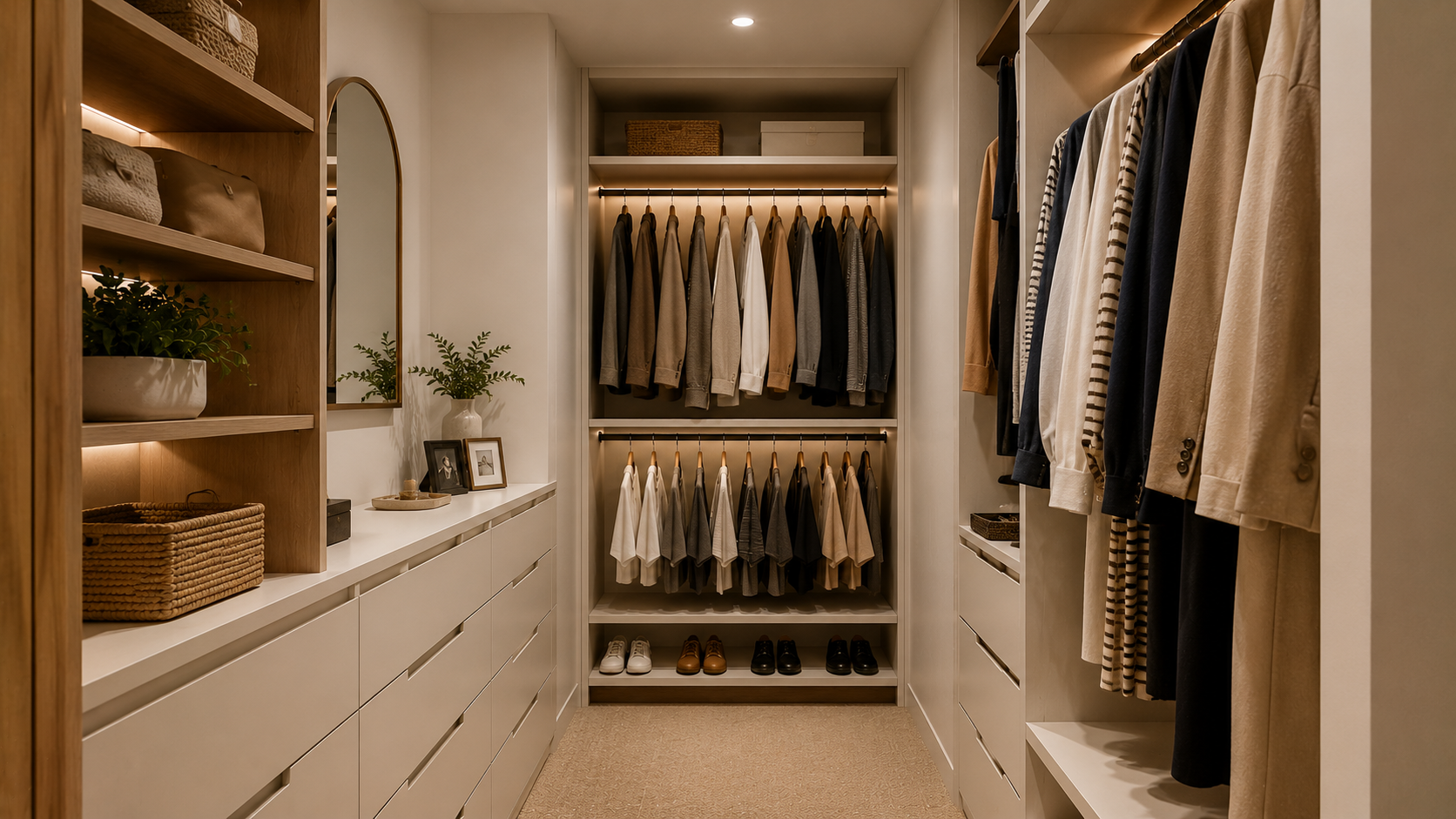
A genuinely functional robe — whether it’s walk-in or built-in — needs more than a rail. The basic kit, for almost any household:
- A run of drawers. This is the biggest miss. Drawers store underwear, socks, T-shirts, knitwear, gym gear, pyjamas, swimwear, accessories. Without drawers, all of that ends up in random plastic tubs on the floor of the robe or on a chest of drawers in the bedroom (which then takes up floor space you didn’t have to lose).
- Open shelving for jumpers and folded items. Some clothes don’t want to hang. Knitwear stretches, gets shoulder bumps from hangers, and looks rubbish over time. Open shelves at a comfortable height for folded stacks of 3–4 items are essential.
- A shoe zone. Tilted shoe shelves, simple flat shelving, or a separate shoe cabinet. Shoes on the floor of the robe is a chaos generator.
- A double-hung section for shorter items. Shirts, blouses, jackets and trousers all fit comfortably in a 1m hanging height. Double-hanging this section doubles your capacity for the same wall length.
- A taller single-hung section for dresses, long coats and suit trousers.
- A handful of hooks for belts, bags, dressing gowns, scarves.
- A drop zone — a small shelf or top of a drawer unit — where you can put down the watch, the wallet, the earrings at the end of the day.
None of this is exotic. It’s the basic, well-thought-out fit-out that every robe should have.
The Cost Argument Is Weaker Than You Think
People assume drawers and shelves add significant cost. They do add cost — but less than most people expect, especially if specified up front.
A run of three or four drawers in the robe might add $1,500 to $3,000 depending on quality and finish. A few open shelves are essentially free in joinery terms — they’re just panels.
For that money, you’ve replaced “we need a chest of drawers and a tallboy in the bedroom, plus a shoe rack in the corner, plus three plastic tubs on the floor of the robe” with a single, integrated, hidden-behind-a-door storage solution.
On the cost of a build, robe fit-out done properly is an exceptional return for the money.
The Bedroom Floor Space Win
Here’s the underrated benefit.
A properly fitted robe absorbs all the storage that would otherwise live in the bedroom: the tallboy, the chest of drawers, the shoe rack, the basket of laundry waiting to be put away, the random tubs.
That gives you back a bedroom that is genuinely a bedroom: bed, bedside tables, maybe an armchair or a desk if there’s space. Clean, calm, restful.
A bedroom cluttered with overflow storage from a poorly-fitted robe is the opposite. It’s where stuff ends up because there’s nowhere else for it to go.
The Built-In Robe Version of This Problem
The same applies to built-in robes (the ones with mirrored or panelled sliding doors). The standard fit-out is exactly the same: a rail, a shelf above it, nothing else.
Built-in robes have less depth than walk-in robes, which can make drawer-fitting trickier (you don’t have a separate room to step into; the drawer has to slide out into the bedroom). But it is absolutely doable, and there are off-the-shelf and custom solutions for built-in robe drawer towers.
If you’re stuck with an existing built-in robe with just a rail, a slimline freestanding drawer unit that sits inside the robe is a quick, cheap upgrade.
A Quick Note on Walk-In Robe Geometry
While we’re here, two other walk-in robe mistakes worth flagging:
- Too much walkway, not enough perimeter. A walk-in robe needs hanging and shelving around the walls, not in the middle. If the robe is too wide and shallow, you waste space on the middle. Long and narrow (with hanging on both long walls and a short shelf at the end) almost always works better.
- Doors that swing into the robe. If the door opens inward, it cuts into the hanging space. Cavity sliders, pocket doors or barn doors are much better choices for a walk-in robe entry.
My Take
A robe is one of the most-used spaces in the house. Most people open and close their robe multiple times a day, every day, for decades. Spending the small extra amount up front to fit it out properly is one of the highest-value decisions you can make in a bedroom.
A rail alone is not a robe. It’s the bare minimum, dressed up to look like a feature.
Design with purpose. Start with a free consultation from our experienced team.
Up Next
Next in the series: bedrooms too small to fit a queen bed properly.
This is Part 10 of the Design Pitfalls in Australian Homes series. Browse the full series to see all the design choices that look great in theory and fall over in real life.
walk-in robes design walk-in robes design walk-in robes design walk-in robes design walk-in robes design walk-in robes design walk-in robes design walk-in robes design