
flyscreens for Australian homes
No Flyscreens
Written by Simone Schenkel
This is Part 20 of the Design Pitfalls in Australian Homes series. A close cousin of the no ceiling fans post. Same theme: cheap passive cooling tools being left out of homes that desperately need them.
What’s Night Purge Cooling?
Australian summers have one feature that’s genuinely working in your favour: the night cools down.
Even on a 38°C day, the temperature usually drops to 18–24°C overnight. That cool night air is a free resource — if you can get it into the house.
Night purge cooling (sometimes called night flushing) is the practice of opening up the house at night to flush out the day’s heat. The cool night air comes in, the hot daytime air goes out, the thermal mass inside the house (slab, walls, tiles) sheds the heat it absorbed during the day, and you wake up to a cool house at 6am that takes hours to heat back up.
Done well, in a well-designed home, night purge can carry you through Australian summer with very little active cooling. It’s the single most effective passive cooling strategy available in our climate.
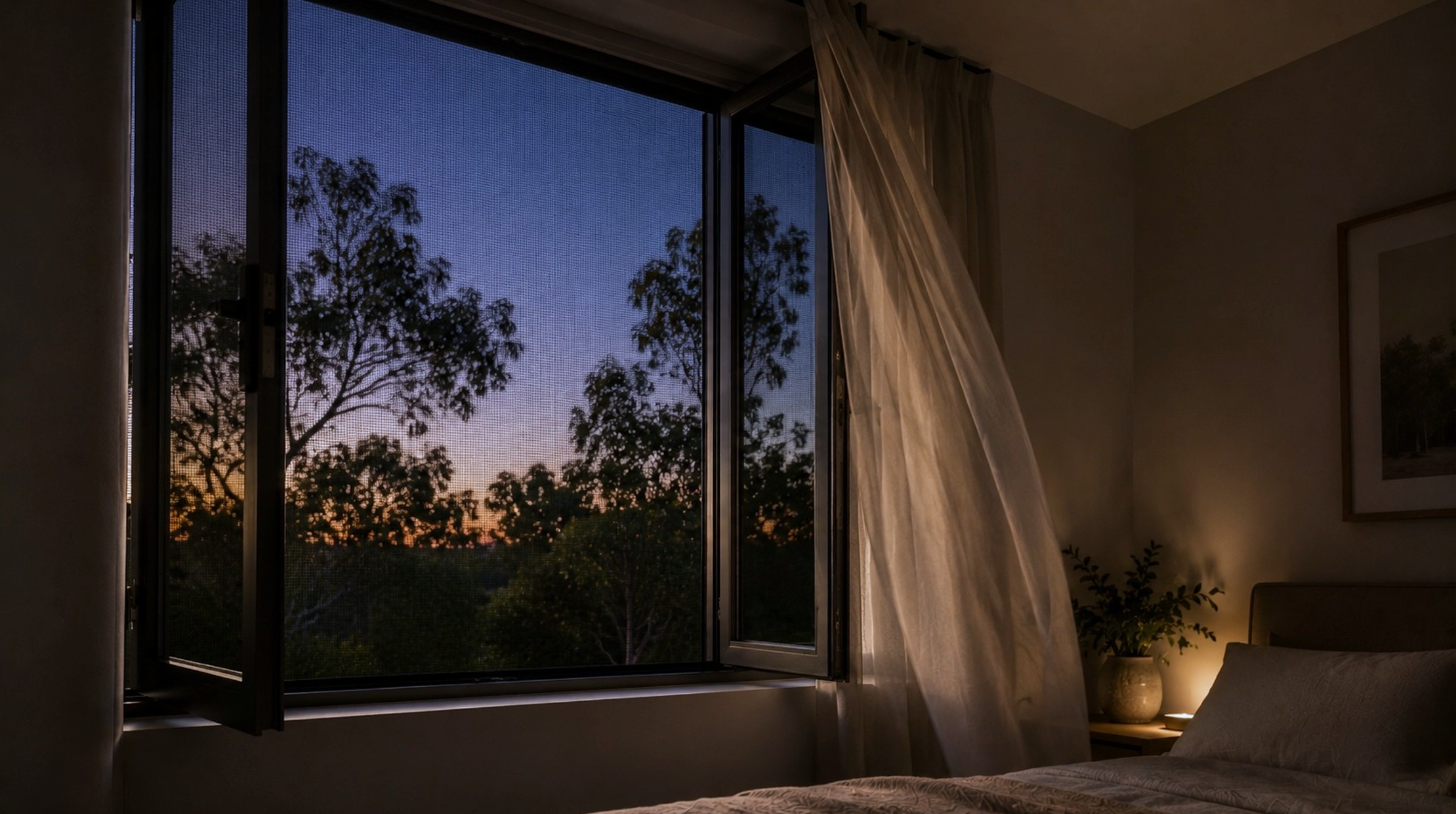
But to make it work, you need more than windows that open. You need flyscreens for Australian homes that allow fresh air in while keeping insects out.
The Catch: You Need to Open the Windows
For night purge to work, you need to actually open the windows at night.
That sounds obvious. It’s also where many Australian homes quietly fall over.
To open a window at night in Australia, you need:
-
A window that opens. (Not a fixed pane.)
-
Security so you can leave it open while you sleep.
-
A flyscreen so mosquitoes, moths, midges and the occasional flying spider don’t come in.
Many new homes — particularly off-the-plan apartments and budget new builds — fail on the third one.
Why Flyscreens Get Left Out
It’s surprising how often. Flyscreens are sometimes:
-
Not included as standard on new builds, sold as an “extras” option that buyers don’t realise they need until move-in.
-
Omitted on operable windows in marketing photos, because frames and mesh “spoil the lines.”
-
Replaced with retractable screens that work poorly and tend to fail (this is especially common on bifold doors).
-
Just forgotten in the specification, because the spec sheet didn’t break them out from “windows.”
-
Skipped on upper-storey windows because the assumption is no insects get up there. (They do.)
The result: an operable window that, in practice, cannot be opened. Or can only be opened during the day, when it’s hot outside and you’d rather have the windows shut.
It’s a surprisingly common oversight in Australian residential design, especially when flyscreens are treated as optional extras rather than an essential part of how the home will function.
What Happens Without Flyscreens
Without flyscreens, the night purge strategy collapses.
You can’t open the bedroom window because mosquitoes will eat you alive while you sleep. You can’t open the living room windows because moths fly in and circle the lights, and possums sometimes come too. You can’t crack the kitchen window because every fly in the neighbourhood appears within ten minutes.
So the windows stay shut.
The hot air inside the house has nowhere to go. The thermal mass stays warm overnight. The house starts the next day already warm. The air-conditioner runs longer to bring it back to comfortable, and the cycle continues.
You’ve effectively converted a home with passive cooling potential into one that depends entirely on mechanical cooling.
This is why flyscreens for Australian homes are about much more than keeping insects out. They’re part of the ventilation strategy that allows a home to release accumulated heat overnight and make better use of cooler outdoor temperatures.
The Cost of a Flyscreen
A flyscreen on a standard window costs somewhere around $80–$200 depending on size and quality. A retractable fly screen on a sliding door is $300–$600. A specialty screen on a bifold or pivoting opening is more.
For a typical house with 10–15 operable windows and 2–3 external doors, comprehensive flyscreening costs maybe $1,500–$3,500.
Against that, the annual saving from being able to night-purge instead of running the air-conditioner is meaningful — easily $200–$500 a year in electricity in a hot summer, often more.
Flyscreens pay for themselves in 3–7 years on energy savings alone. And they last decades.
This is one of the highest-return, lowest-cost upgrades in any Australian home. When you consider the role flyscreens play in ventilation, comfort and energy use, they’re an easy inclusion to justify in both new builds and renovations.
The Window Design Connection
Some of the design choices I’ve covered earlier in this series make the flyscreen problem worse.
Bifold doors are notoriously hard to flyscreen well. Retractable systems work, but they’re expensive and unreliable.
Large casement and awning windows can be flyscreened easily — the screen sits on the inside of the window. Vertical sliding (double-hung) windows are also straightforward. Top-hung awning windows are excellent for night purge because they can be left ajar in light rain without water coming in.
When designing or renovating, think about flyscreen integration at the window selection stage. A window type that doesn’t flyscreen cleanly is going to undermine your night purge strategy from day one.
For anyone specifying flyscreens for Australian homes, the key is to consider the screen alongside the window itself, rather than trying to find a solution after installation.
Security at Night
Linked to flyscreens is security. If you want to open windows at night for cooling, those windows need to be secure enough that you’re comfortable sleeping with them open.
This is largely about:
-
Window restrictors and locks. Allow the window to open 100–150mm — enough for serious airflow — but lock at that position so it can’t be opened further from outside.
-
Window type and position. First-floor windows or windows in protected positions (covered by an eave, a balcony, a courtyard) are easier to leave open securely.
-
A grille or security screen on ground-floor operable windows if you live in an area where you’d otherwise feel unsafe.
-
A working alarm system if you’re concerned about leaving the house open.
The combination of flyscreens (no bugs), restrictors (no intruders) and ceiling fans (active air movement to make the night purge effective) is the trio that lets a home actually use the cool night.
The Connection to the Heat Post
This whole topic ties back to my Heat, Health and Housing post, where I described how my daughter’s bedroom in our rental hits 30°C by 11am.
My current rental has no flyscreens at all. Not on a single window.
The result is exactly what you’d expect. We can’t open the windows at night without inviting every mosquito in the neighbourhood inside. So the windows stay shut. The heat from the day has nowhere to go. The thermal mass stays warm overnight. The house starts every morning already loaded with the previous day’s heat, and by mid-morning the bedrooms are unbearable again.
It is a completely avoidable problem. Flyscreens are not a premium product. They are not a technical challenge. They cost almost nothing relative to the build. And yet here we are — in a relatively modern, well-finished rental — without a single one.
In a comparable Passive House with proper night purge capability — operable windows, proper flyscreens, good cross-ventilation — the same outside conditions would translate into a much cooler internal temperature in the morning, and the heat load on the cooling system would be a fraction of what it is now.
The flyscreen — the humble, cheap, almost universally omitted flyscreen — is one of the small, unglamorous components that makes an enormous difference to how a home actually performs in an Australian summer.
What to Specify
For any new build or renovation, my flyscreen specification is simple:
-
Every operable window gets a flyscreen. Including upstairs.
-
Every external door that opens gets a flyscreen door (often a separate sliding flyscreen on a parallel track).
-
Specify quality mesh (fibreglass or aluminium, not the cheap plastic kind that distorts and tears).
-
Specify openable flyscreen panels on hinged windows so you can clean the glass on the inside without removing the screen.
-
For bifold doors, accept the cost of a serious retractable system or strongly consider a sliding door instead.
When choosing flyscreens for Australian homes, make sure the specification covers every operable opening, including upper-storey windows and external doors. It’s much easier to plan this properly before construction than to retrofit a solution later.
My Take
A flyscreen is one of the cheapest, simplest, most boring components in a house. It also unlocks one of the most powerful passive cooling strategies we have. Leaving them out is one of the most economically and thermally short-sighted decisions a builder or developer can make.
If you’re moving into a place that doesn’t have them, retrofit them. If you’re building, specify them on every operable opening from day one. Then actually use them — open the house at night when it’s cool, shut it up in the morning when the day heats up, and let the cool night do the work the air-conditioner would otherwise have to do.
Flyscreens should be considered a basic part of good home design in Australia, not an optional upgrade.
Up Next
Last in the series: no proper external clothesline — and why it drives indoor mould.
This is Part 20 of the Design Pitfalls in Australian Homes series. Browse the full series to see all the design choices that look great in theory and fall over in real life.