
Shading Your Home Properly: One of the Most Powerful (and Overlooked) Design Tools
If you’ve read Simone’s recent post about returning to the rental market after living in a Passive House, you’ll already know how confronting that experience has been — particularly during summer.
Despite being a relatively new home, my current rental struggles badly with heat. Dark roof and wall colours, large areas of unprotected glazing, no overhangs, and not a single form of external shading mean that even mild days quickly turn into uncomfortable indoor conditions. On hot days, rooms overheat early and stay hot well into the evening — regardless of how carefully we manage windows, blinds or air-conditioning.
What’s most frustrating is that this overheating was entirely avoidable.
Not through expensive technology or complex systems, but through simple, well-understood design decisions: shading windows properly, choosing appropriate colours, and responding to orientation. None of these would have required a bigger budget — just better design thinking.
That experience is what prompted me to write this post.
Because shading is one of the most powerful tools we have to control heat, improve comfort and protect health — and yet it’s still routinely overlooked, particularly in speculative housing and rentals. So let’s unpack how shading actually works, why external shading always matters most, and how homes could — and should — be doing this far better.
Shading Your Home Properly: One of the Most Powerful (and Overlooked) Design Tools
When it comes to keeping homes comfortable, healthy and resilient in a warming climate, shading is one of the simplest and most effective tools we have — and yet it’s often treated as an afterthought.
With heatwaves becoming more frequent and intense across Australia, how we control solar gain is no longer just a comfort issue. It’s about health, energy use, and long-term liveability.
Whether you’re designing a new home, renovating, or trying to improve an existing one, good shading can dramatically reduce overheating — often before you even think about air-conditioning.
Let’s break it down.
Why Shading Matters (More Than You Think)
Once sunlight hits glass, the heat is inside your home.
At that point, curtains, blinds or air-conditioning are already playing catch-up.
That’s why, from a building physics perspective, external shading is always more effective than internal shading.
Good shading can:
Reduce internal temperatures by several degrees
Cut cooling energy demand significantly
Improve thermal comfort and sleep quality
Reduce glare while maintaining daylight
Protect windows and finishes from UV damage
Both passive solar design and Passivhaus principles rely heavily on getting shading right — because controlling heat before it enters the building is far more efficient than trying to remove it later.
External Shading: Your First Line of Defence
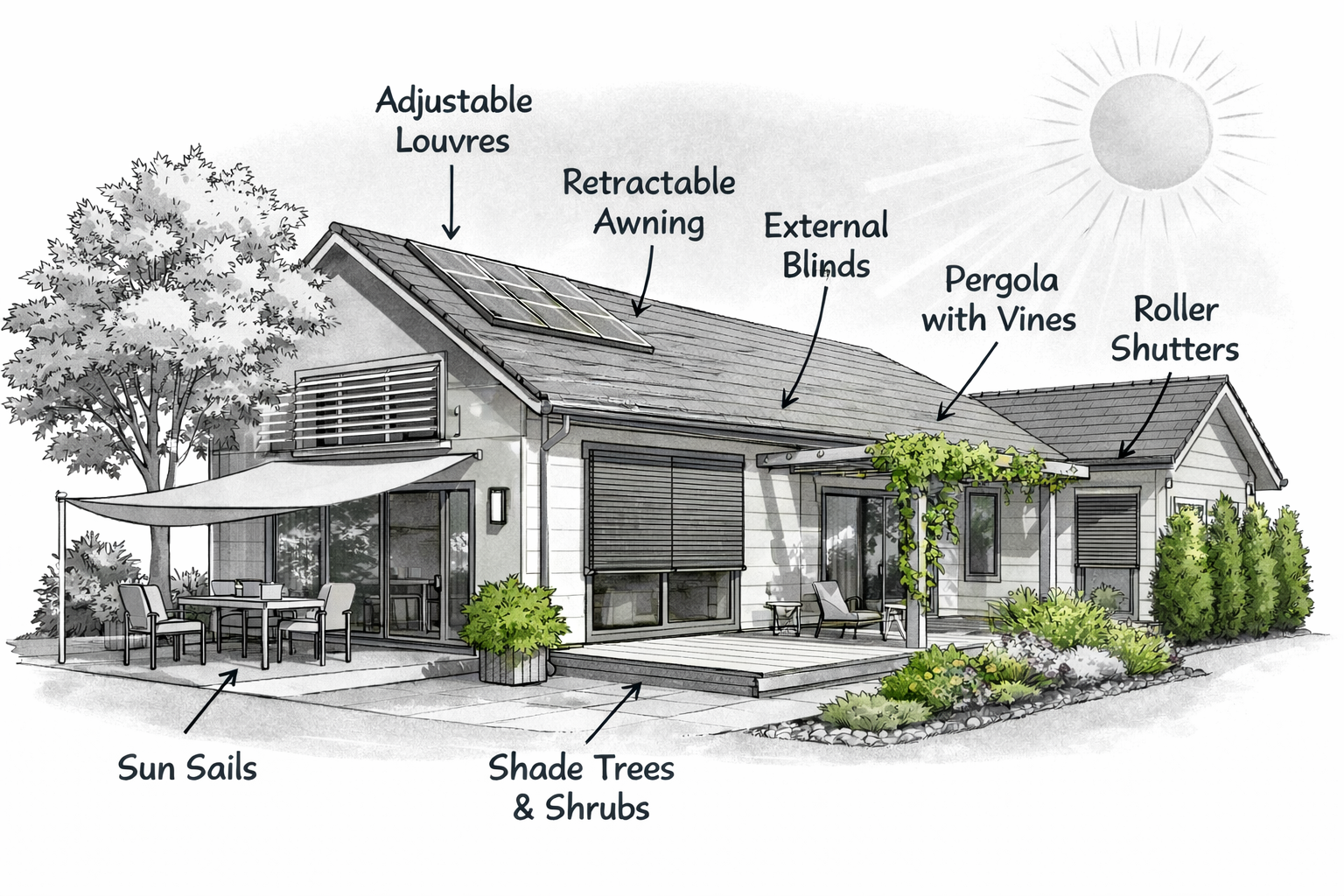
1. Fixed Shading: Eaves & Overhangs
This is classic passive solar design — and it works.
North-facing windows benefit most from fixed horizontal shading
Properly sized eaves allow winter sun in while blocking high summer sun
Simple, durable, low-maintenance
Zero moving parts, zero energy use
The catch?
They need to be designed correctly, based on orientation, latitude and window height. Too often, eaves are either too small to work or missing altogether.
2. External Blinds & Screens
External blinds are one of the most effective retrofit options.
Types include:
Zip-track blinds
Roller shutters
External mesh or fabric screens
Benefits:
Stop heat before it hits the glass
Can reduce solar heat gain by 70–90%
Adjustable — shade when you need it, daylight when you don’t
Available in manual or motorised options
Things to consider:
Wind ratings and durability
Quality of fixings (cheap systems fail quickly)
Colour choice (lighter colours reflect more heat)
Store-bought vs custom-made:
Store-bought options can work well for standard openings and tight budgets
Custom-made systems perform better for large glazing, odd sizes or high wind areas
Custom doesn’t always mean wildly expensive — but it does mean better fit and longevity
3. Louvres & Adjustable Shading Systems
Louvres offer excellent control and are widely used in high-performance buildings.
Can be fixed or operable
Allow airflow while blocking direct sun
Particularly effective on east and west façades
Can be integrated into façades or pergolas
They are more of an upfront investment, but from a Passivhaus and long-term comfort perspective, they’re a very elegant solution.
4. Shade Cloth & Temporary Solutions
Not glamorous — but very effective.
Shade cloth over pergolas, balconies or problem windows
Great for renters or short-term fixes
Cheap, fast and surprisingly powerful
Can reduce radiant heat significantly
DIY solutions like these can make a real difference during heatwaves — especially when paired with night-time ventilation.
Internal Shading: Helpful, But Secondary
Internal blinds, curtains and shutters still have a role — just not as your main defence.
They help with:
Glare control
Privacy
Reducing radiant heat transfer after sun has entered
But they do not stop solar heat gain at the source.
In high-performance homes, internal shading is usually paired with:
External shading
High-performance glazing
Good ventilation strategies
Think of internal shading as supporting cast, not the hero.
Shading with Plants: Nature Does It Best
One of the most underrated shading strategies is landscape design.
Deciduous trees
Provide shade in summer
Allow sun through in winter
Ideal for north and west sides
Climbers and green screens
Reduce surface temperatures
Cool air through evapotranspiration
Improve microclimate and wellbeing
Pergolas with planting
Flexible, beautiful, climate-responsive
Combine built and natural shading
This approach aligns beautifully with both passive solar principles and biophilic design — cooling your home while improving mental health and biodiversity.
DIY vs Designed Solutions
There’s no one-size-fits-all answer.
DIY solutions are great when:
You’re renting
You need immediate relief
Budget is tight
You’re testing what works before investing
Designed solutions are worth it when:
You’re building or renovating
You have large areas of glazing
You want long-term performance
You’re aiming for Passivhaus or high-performance outcomes
The key is understanding where your heat is coming from, and addressing that first.
Shading in Passivhaus & High-Performance Homes
In Passivhaus design, shading is not optional — it’s a core design element.
Overheating risk is modelled early
Shading is designed per façade, not one size fits all
External shading is prioritised
Operable shading allows occupants to adapt to changing conditions
Even if you’re not aiming for certification, applying these principles will massively improve comfort.
The Big Takeaway
Shading is not about aesthetics or add-ons.
It’s about designing for reality.
As our climate changes, homes that rely solely on air-conditioning will become expensive, uncomfortable and vulnerable during extreme heat events.
Good shading:
Is low-tech
Is cost-effective
Works with physics, not against it
Makes homes healthier and more resilient
And best of all?
Much of it can be done simply, affordably, and right now.
If you’re unsure where to start, or want help assessing shading options for your home or project, that’s exactly where good design advice — grounded in passive solar and Passivhaus thinking — can make all the difference.
Because comfort isn’t accidental.
It’s designed.