
biophilic design
Your Brain on Nature: The Neuroscience of Biophilia — and How We Design For It
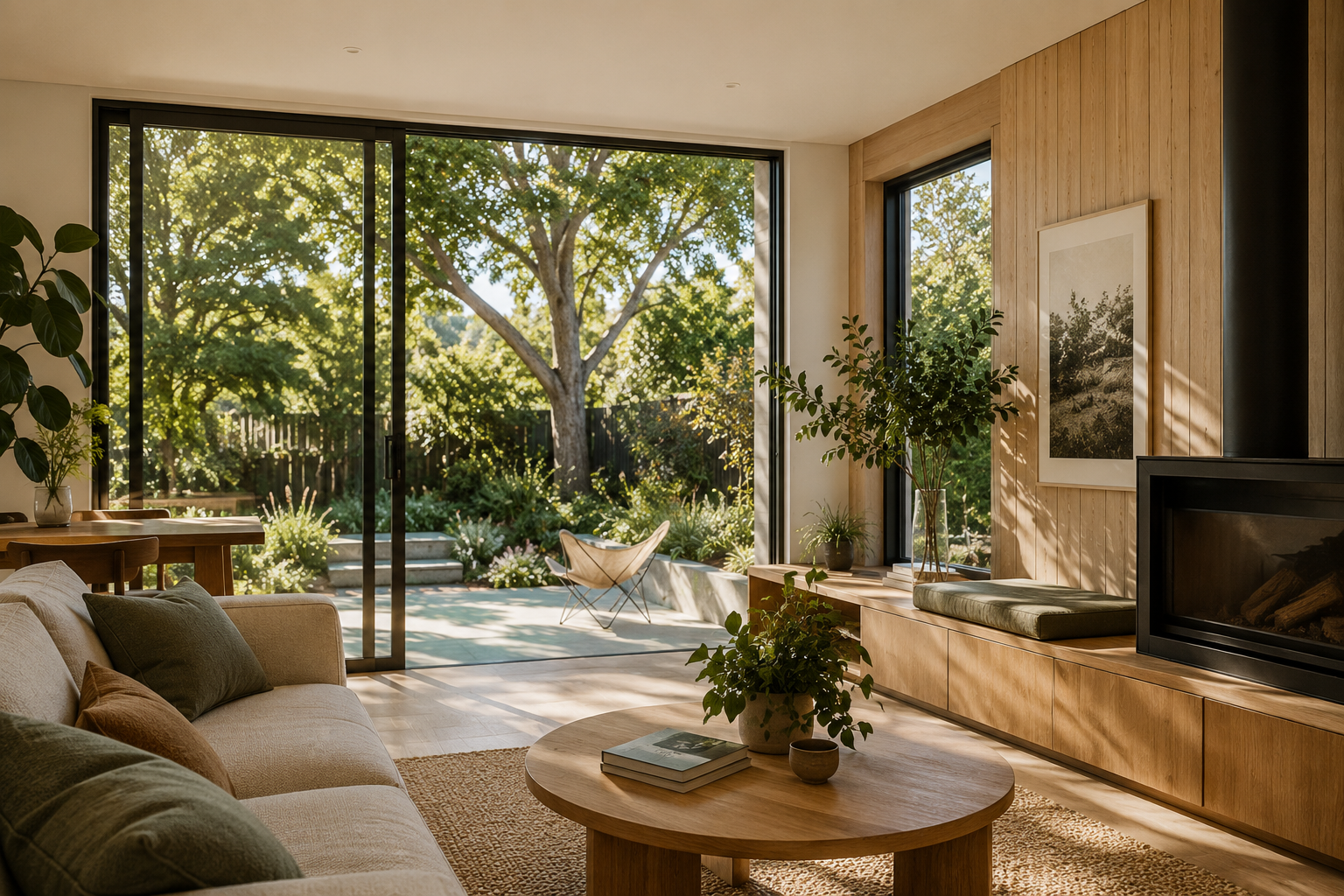
We’ve written before about biophilia and reconnecting with nature through thoughtful design. But there’s a question that sits underneath it that I find endlessly fascinating: why does being near nature make us feel so much better? It turns out this isn’t just a nice feeling or an interior-design trend. There’s real neuroscience behind it — and once you understand what’s happening in the brain, the way we design and build homes starts to look a little different.
What biophilia actually means
“Biophilia” is the idea, popularised by biologist E.O. Wilson, that humans have an innate, evolved affinity for the natural world. We spent almost the entirety of our history outdoors, embedded in living landscapes. The enclosed, artificially lit, mechanically conditioned box is a very recent experiment — and our nervous systems haven’t caught up.
Biophilic design is simply the practice of bringing that connection back into the built environment: natural light, views of greenery, natural materials, fresh air, water, natural forms and even the gentle variability of the outdoors. Not as decoration, but as something the body genuinely needs.
What the research shows is happening in your brain
Here’s where it gets interesting. The effects of nature on the brain and body are measurable, and researchers have converged on two big explanatory theories.
Stress Recovery Theory. Exposure to natural environments is consistently associated with lower physiological stress. Studies link it to reduced activity in the amygdala — the brain’s threat-detection centre — along with lower levels of cortisol (the primary stress hormone), reduced blood pressure, and a lift in mood-regulating neurotransmitters like serotonin. In plain terms: nature tells your nervous system it’s safe to stand down.
Attention Restoration Theory. Developed by Rachel and Stephen Kaplan, this proposes that natural settings restore our depleted capacity for focus. Modern life demands constant directed attention — screens, decisions, noise — which fatigues the brain. Nature engages our attention gently and involuntarily (a term the Kaplans called “soft fascination”), letting the directed-attention system recover. It’s why a walk in a park leaves you clearer-headed than a walk through a busy shopping centre.
There’s imaging evidence too: even looking at images of nature has been shown to engage the brain’s default mode network, associated with introspection, creativity and emotional regulation. One of the most famous studies, going back to the 1980s, found hospital patients with a view of trees recovered faster and needed less pain medication than those facing a brick wall. Same surgery, different view, measurably different outcome.
A quick note of honesty: this is a growing field, effect sizes vary between studies, and a home isn’t a clinical trial. But the direction of the evidence is remarkably consistent — our brains and bodies respond to nature, and to its absence.
The part everyone forgets: air is biophilic too
We tend to picture biophilia as visual — plants, timber, a leafy outlook. But some of the most powerful nature-connection is invisible: the quality of the air you’re breathing.
This is where a separate but related body of research is striking. Harvard’s COGfx studies measured cognitive performance in different indoor environments and found that people scored dramatically higher on cognitive tests in well-ventilated “green” buildings than in conventional ones — in the enhanced-ventilation condition, scores were roughly double. They also found that as carbon dioxide levels climbed, response times and decision-making measurably slowed.
Think about what that means for a home. Stuffy, high-CO₂, poorly ventilated rooms don’t just feel unpleasant — they dull the brain. Fresh, clean, filtered air isn’t a luxury; it’s a cognitive and physiological input, every bit as much as daylight. It’s a big part of why we treat indoor air quality as central rather than incidental.
Where this meets Passive House
Here’s the connection I most want to make, because it’s rarely drawn. People think of Passive House as an energy standard. But the very same design decisions that make a passive house perform are the decisions that deliver these neurological and physiological benefits. Performance and wellbeing aren’t in tension — they’re produced by the same moves.
- Daylight. Getting orientation and glazing right for thermal performance also floods a home with natural light and frames the views that feed the visual side of biophilia. Choosing the right windows and placing them well serves comfort, energy and the brain’s need for a connection to the sky, the weather and the green outside.
- Air. A passive house’s heat recovery ventilation delivers a continuous supply of filtered, fresh, low-CO₂ air to every room — precisely the condition the cognitive research points to. You get the “just opened a window” freshness without opening a window, all day, every day.
- Thermal comfort and calm. A stable, even temperature with no cold draughts or hot spots keeps the body out of low-grade stress. Add the deep quiet of a well-sealed, well-insulated home — acoustic calm is its own kind of sanctuary — and you’ve removed two chronic, subtle stressors most people don’t even notice until they’re gone.
- Natural materials. Our preference for timber and honest, tactile materials isn’t only about carbon. Natural materials, grain and texture are part of the biophilic palette the brain responds to.
So a genuinely well-designed passive house is quietly biophilic by construction. The healthy, restorative home and the high-performance home turn out to be the same home — which is really what we mean when we say Passive House is about so much more than energy.
How we design for it, deliberately
Understanding the neuroscience changes how we make decisions. Rather than treating “connection to nature” as a finishing touch, we build it in from the first sketch:
- Orient living spaces and bedrooms to capture daylight and the best natural outlook, while managing summer heat with proper shading.
- Frame specific views — a tree, a garden, the sky — so the eye has somewhere restorative to rest from every room you spend time in.
- Design for genuine indoor-outdoor flow, so stepping outside is effortless and habitual.
- Prioritise fresh, filtered air and a stable, quiet, comfortable interior as baseline conditions, not extras.
- Choose natural, tactile materials that the senses respond to.
None of this competes with performance. It is performance — of the human kind.
The short version
Our affinity for nature is wired in, and the science shows why it matters: contact with nature lowers stress-hormone activity, calms the brain’s threat response, and restores our capacity to focus, while fresh, low-CO₂ air measurably sharpens cognition. The quiet beauty of it is that the design decisions behind a high-performing passive house — daylight, clean air, thermal calm, quiet, natural materials — are the very same ones that deliver those benefits. Build for the planet and the power bill, and you end up building for the brain too.
If you’d like a home designed to perform and to feel like somewhere your nervous system can finally exhale, let’s talk.
Or make your first design decision your best one. Book a free consultation.
This article summarises general research on biophilia and indoor environmental quality. The science is evolving and individual responses vary — but the design principles it points to are ones we apply on every project.
biophilic design biophilic design biophilic design biophilic design biophilic design biophilic design biophilic design biophilic design