
home energy performance australia
Your Home's Energy Performance Is About to Go Public. Here's Why That's Good News.
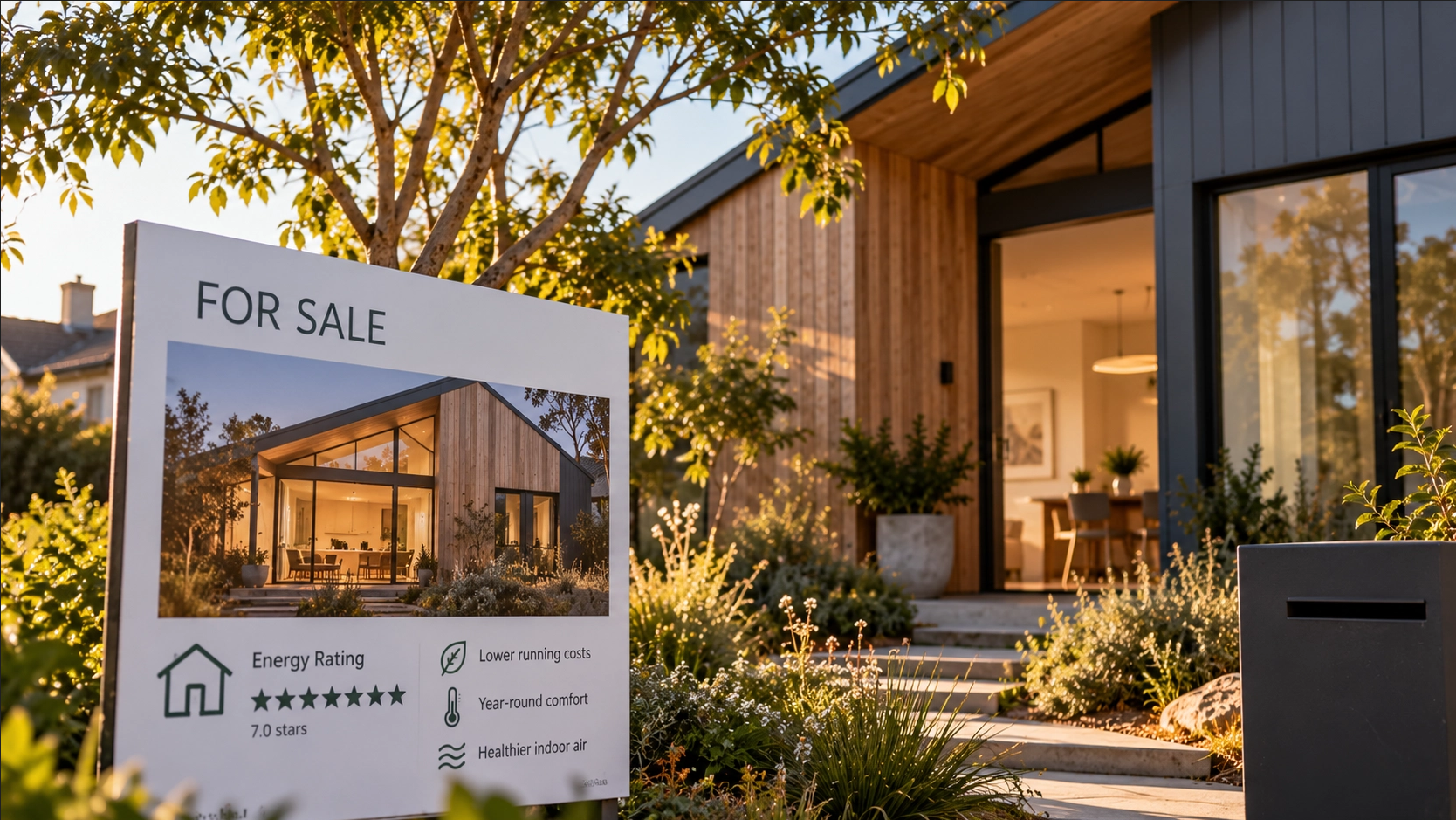
For years, buying a home in Australia has involved a strange blind spot. You can find out more about the energy use of a $1,000 washing machine than a $1 million house. You can see the size, the location, the renovated kitchen and the outdoor deck — but how the home actually lives? Whether it’s warm in winter, cool in summer, cheap to run, healthy to be in? That, you’ve largely had to guess.
That’s changing. And a recent report from the Real Estate Institute of Australia (REIA), The Rise of Home Energy Performance in Real Estate, lays out just how quickly. As the people who design and build homes to perform, we think this is one of the most encouraging shifts in Australian housing in a long time — so here’s what’s happening and what it means for you.
The Performance Gap No One Could See
Most of Australia’s homes were built in an era of cheap energy and weak building standards. The result is a huge, mostly invisible gap between how homes perform. Two houses of the same size, age and street can cost wildly different amounts to keep comfortable.
The REIA report puts numbers on it: around 70% of established Australian houses are estimated to perform below 4 stars out of 10 under NatHERS, while new homes must now meet a 7-star minimum. And improving a home from just 3 to 5 stars can cut heating and cooling energy use by around 40%. That’s the difference between a home that works with you and one you’re forever paying to fight — something we’ve written about in why so many Australian homes are cold, hot and expensive to run.
The problem has always been that none of this was visible at the point of sale. You couldn’t compare it, so it couldn’t be valued. That’s exactly what’s now shifting.
Understanding home energy performance in Australia is becoming increasingly important because buyers and renters can finally start comparing how much it costs to live in a property, not just what it costs to purchase or rent.
Disclosure Is Arriving
Australia’s framework for measuring home performance — NatHERS — has existed since 1993, but mostly for new builds. As of 1 July 2026, NatHERS for Existing Homes (Stage 2) gives us a nationally consistent way to assess the homes most of us actually live in. Every state and territory has agreed to a nationally aligned Home Energy Ratings Disclosure Framework, and there’s now a national platform, homeenergyrating.gov.au.
The ACT has required an energy rating at the point of sale since 1999 — more than two decades of proof that disclosure can simply become a normal part of buying and selling. New South Wales is moving toward it, Victoria will have minimum energy efficiency standards for rentals from 2027, and other states are following.
And people want this. The Australian Government’s own research found 86% of buyers and 75% of renters think it’s important to see a home’s energy rating. We’re finally catching up to what much of Europe has taken for granted for years: that comfort, running costs and efficiency belong in the conversation when you choose a home.
This growing focus on home energy performance in Australia means energy ratings are moving beyond technical building assessments and becoming information that everyday property buyers and renters can use.
The Part That Will Surprise People: Performance Now Shows Up in Price
Here’s where it gets real. A better-performing home isn’t just nicer to live in — the market is increasingly paying for it.
The report cites Cotality analysis of more than six million homes finding houses with solar sold for around 2.7% more than comparable homes without, and that each additional NatHERS star was associated with roughly 1.3% more value nationally. The case studies are even more striking:
A contemporary, off-grid home in Cygnet, Tasmania sold for about 66% above the local four-bedroom median — its double glazing, thermal mass, battery and low running costs made it genuinely rare.
A compact, well-designed home in Mount Hawthorn, WA drew a full-price offer the same day and sits around 14–24% above comparable sales — the buyers weren’t asking for “energy efficiency,” they were asking for natural light, cross-ventilation and a home that felt good and cost little to run.
A 7.5-star townhouse in Fremantle sold 22% above the median and pulled buyers from well outside the usual catchment.
In O’Connor, ACT, tenants happily paid about 35% more to rent a six-star home over a 2.5-star one — and their first power bill came back in credit.
Notice the pattern: in almost every case, buyers and renters weren’t using technical language. They wanted a home that was comfortable, healthy and affordable to live in. Performance was simply how they got it.
These examples show why home energy performance in Australia is becoming a more significant part of property value. The benefits aren’t limited to lower energy bills; they can also influence buyer interest, rental appeal and the long-term value of a home.
What This Means If You’re Building, Buying or Renovating
This shift rewards exactly the things we care about — and it has practical implications.
If you’re building or buying new: performance is becoming a visible, valued asset, not an optional extra. A home designed to be comfortable and cheap to run will increasingly be worth more and easier to sell. It’s a strong argument for getting the fundamentals — orientation, insulation, glazing, airtightness, ventilation — right from the first sketch.
If you own an older home: that invisible performance gap is about to become visible. The good news is that improvements like insulation, draught sealing, better glazing and solar don’t just lower your bills and make the home healthier to live in — they’re increasingly reflected in value too. There’s real support available now, including the Federal Government’s $1.3 billion Household Energy Upgrades Fund and green home loans from the major banks. Our step-by-step guide to deep retrofit is a good place to start.
One honest caution: a rating is a starting point, not the whole story. As we’ve written in can you really trust a 7-star rating?, a modelled number isn’t the same as verified, built performance. Disclosure is a huge step forward — but how a home is actually built still matters enormously.
As home energy performance in Australia becomes more visible, it’s worth remembering that a rating alone doesn’t guarantee a comfortable, efficient home. Good design, careful construction and attention to the details all matter.
The Bigger Picture
For a long time, we’ve argued that the real question isn’t only what a home costs to buy, but what it costs to live in. What’s exciting about this report is that the whole industry — governments, lenders, real estate agents, property platforms — is finally moving in that direction. The market is starting to reward decent, healthy, resilient homes: the kind that hold their temperature, keep their occupants well, and don’t punish you every time a bill arrives.
That’s not a niche concern for enthusiasts anymore. It’s becoming the ordinary expectation — and that’s exactly how it should be.
If you’d like a home that’s comfortable, healthy and genuinely affordable to live in — and that stands up when performance becomes visible — let’s talk.
This article draws on the Real Estate Institute of Australia’s report on home energy performance in real estate (2026), with figures from NatHERS, Cotality, the Clean Energy Council and Australian Government sources. Shared with thanks and full credit to the REIA.