
skylight overheating skylight overheating skylight overheating
Skylights Without External Shading
Written by Simone Schenkel
This is Part 18 of the Design Pitfalls in Australian Homes series. We continue the chapter on passive design pitfalls.
Why Skylights Sound So Appealing
Skylights are one of those features that look like a free win.
You drop one in and suddenly:
- A dark bathroom or stairwell is flooded with daylight.
- A long internal hallway feels open and bright.
- A kitchen with no good external window has natural light from above.
- The whole room reads more spacious, more alive, more beautiful.
I love a well-placed skylight. In the right room, with the right design, a skylight can be the single best move in the house.
The trap is that “well-placed” and “with the right design” gets quietly skipped in many homes. The skylight goes in. The shading doesn’t.
That’s when skylight overheating becomes a problem, particularly during Australian summers.
The Problem: Australian Sun From Above
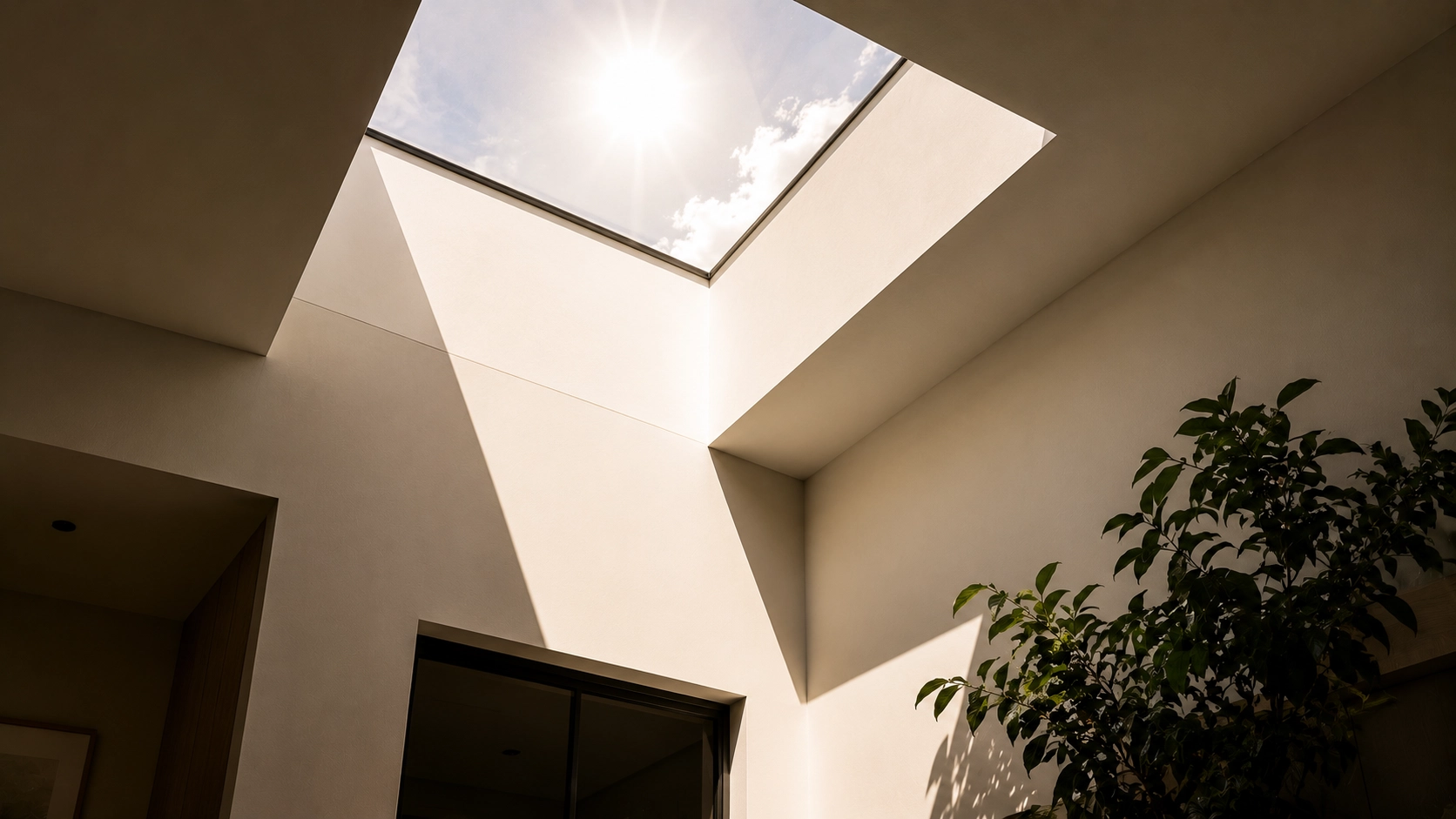
The Australian sun in summer is brutal. We have one of the highest solar radiation levels of any developed country. A square metre of unshaded glass on a hot day takes enormous amounts of heat energy directly into the room below.
Here’s the geometry that matters:
- A vertical window can be shaded by an eave, an overhang, an awning or a planted tree. The sun’s angle in summer is high, so a properly sized eave keeps direct summer sun out of the window. In winter, the lower sun gets under the eave and warms the room.
- A skylight in the roof has no such option. The sun in summer is hitting it from directly above, at the peak heat-load angle. There’s no eave that can shade a horizontal piece of glass.
An unshaded skylight is essentially a magnifying glass focused on the room below.
Internal blinds and shades help a bit, but they catch the heat after it has already entered the room through the glass. The glass surface itself heats up, the air below the skylight heats up, the blind itself heats up — and then it all radiates into the room. You’ve reduced the glare, not the heat.
This is why preventing skylight overheating requires more than choosing a blind or a darker interior finish. The most effective strategy is to stop solar heat before it passes through the glass.
The only really effective answer is external shading.
What External Skylight Shading Looks Like
External shading on a skylight can take several forms:
- External roller blinds purpose-designed for skylights, sitting above the glass. Cassette-style external blinds that can be retracted in winter and extended in summer. These are the standard “proper” answer — effective but more expensive than internal shades and they need to be specified and installed up front.
- A purpose-built shading “eyebrow” or overhang above the skylight, sized to block direct summer sun while allowing diffuse light in.
- A pergola, slatted roof element or planted tree above the skylight that filters direct sun.
- An external mesh or fabric screen fixed permanently or seasonally over the skylight.
The key principle: the heat has to be stopped outside the glass, before it gets in.
For homes in Australia, planning external shading from the beginning is one of the most important steps in reducing skylight overheating without giving up the daylight that made the feature appealing in the first place.
What Happens Without It
I’ve been in plenty of Australian homes — including beautifully designed ones — where the skylight is the single biggest contributor to summer overheating in the affected room.
In a kitchen with a 1m × 1.5m skylight and no external shading:
- The room can be 5–8°C hotter than the rest of the house by mid-morning on a 30°C day.
- The air-conditioner cannot keep up, because the heat source is uncovered and constant.
- The space directly beneath the skylight is unusable as a working zone — too hot, too bright, glaringly uncomfortable.
- Cooking adds more heat to a room that’s already overheated, and the kitchen quickly becomes unbearable.
These are the kinds of problems that make skylight overheating more than a minor comfort issue. A feature intended to improve a room can make it one of the least comfortable spaces in the home.
I described in the Heat, Health and Housing post how my daughter’s bedroom in our current rental hits 30°C by 11am even on mild days. A west-facing wall and dark roof are doing most of that work. But I have walked into homes where a single unshaded skylight is doing the same thing on its own.
The Tubular Skylight Question
A quick note on tubular skylights (the small reflective tubes that funnel light from a small dome on the roof down into a ceiling diffuser).
Tubular skylights are much less of a heat-load problem than large flat or pyramid skylights, because:
- The aperture at the roof is small.
- The reflective tube tends to lose some heat along the way.
- The light is delivered diffuse rather than direct.
They still introduce some solar gain in summer, but it’s much more manageable than a large clear-glazed traditional skylight. For dark bathrooms, walk-in robes, hallways and small kitchens, a tubular skylight is often a better choice than a full skylight if you don’t have shading capability.
If you’re concerned about skylight overheating but still want to bring natural light into a darker part of your home, a tubular skylight may offer a practical compromise.
An Alternative Worth Considering: Solar LED “Skylights”
There’s another option that has improved enormously in recent years and deserves far more attention in Australian homes: solar LED skylights (sometimes called virtual skylights or artificial skylights).
These systems use a roof-mounted solar panel or standard electrical connection combined with a ceiling-mounted LED panel designed to mimic the look and feel of natural daylight coming through a skylight.
And honestly, some of the newer products are surprisingly convincing.
No — you don’t get:
- a real sky view
- clouds passing overhead
- or direct sun beams entering the room.
But you do get:
- soft daylight-style illumination
- the psychological feeling of light from above
- and a much brighter, more pleasant space
without many of the thermal and construction issues that traditional skylights introduce.
The big advantages are significant:
- No roof penetration through the thermal and weatherproofing layer.
- No overheating risk from direct solar gain.
- No potential leak points from poorly detailed flashing.
- Much lower installation costs in many situations.
- Better energy efficiency overall.
- No need for external shading systems.
- Works well in apartments or complex roof geometries where a real skylight isn’t practical.
For spaces like:
- internal hallways
- pantries
- walk-in robes
- laundries
- powder rooms
- or darker circulation zones
they can actually be an excellent solution.
In these rooms, people don’t necessarily need a sky view. What they really need is the feeling of natural light.
And a good-quality solar LED skylight can deliver much of that effect with far fewer compromises.
Personally, I still strongly prefer a real skylight in spaces where:
- connection to the sky matters
- daylight quality is central to the room experience
- or where natural ventilation can also be incorporated.
For example:
- kitchens
- bedrooms
- living spaces
- stair voids
can genuinely benefit from real roof glazing when designed properly with shading and ventilation.
But for many secondary spaces in Australian homes, I think artificial skylights are currently underrated — especially given how much overheating we already struggle with in our climate.
Sometimes the smarter design move is not:
“How do we maximise glass?”
but:
“How do we maximise daylight and comfort together?”
The “Energy-Rated Glass” Marketing Trap
Many skylight products are sold with energy-rated glass — typically double-glazed, often with a low-e coating, sometimes with solar-control tinting.
These help. They cut solar heat gain significantly compared to plain single-glazed skylights. They are absolutely better than uncoated single glass.
They do not eliminate the problem.
A high-spec double-glazed solar-control skylight still transmits significant solar heat in the middle of an Australian summer. The product spec sheet might tell you it blocks 60–70% of solar heat gain. That sounds great, until you realise the 30% that does get through is still equivalent to a large heater running for hours in the middle of the day.
Good glass is a partial answer, not a complete one. External shading is still the right move for a skylight that’s getting direct summer sun.
When specifying a skylight, don’t assume energy-rated glass alone will prevent skylight overheating. Glazing, shading, orientation and ventilation need to be considered together.
How to Specify a Skylight Properly
If you’re putting a skylight into a home design or renovation, the checklist:
- Orientation. A north-facing skylight (in the southern hemisphere) is the most controllable. South-facing has no real winter solar gain. East and west-facing skylights are the trickiest, with low-angle morning or afternoon sun coming in at angles that are very hard to shade.
- Size. Don’t go bigger than the room actually needs. The room only needs so much daylight; more skylight area means more heat load with diminishing returns.
- Glazing spec. Double-glazed, low-e, solar-control glass minimum. This is the baseline, not an upgrade.
- External shading. Either a fixed shading element (overhang, pergola) or a controllable external blind. Plan for this up front.
- Ventilation. If the skylight is openable, you get the bonus of stack-effect ventilation in summer. Heat rises and escapes through the open skylight, pulling cooler air in through low windows. This is a genuinely powerful passive cooling strategy.
- Insulation around the shaft. If the skylight is in a roof void, the shaft from the ceiling up to the roof glass should be well-insulated. Otherwise the shaft itself becomes a heat-conducting hole.
Considering these details early helps prevent skylight overheating from becoming an expensive problem to fix after construction.
The Best Use of Skylights
When all of the above is done well, skylights are wonderful. They work brilliantly in:
- Internal bathrooms with no external wall, where they’re often the only source of natural light. (Pair with proper ventilation — see the upcoming bathroom ventilation post if I add one to the series.)
- Stairwells and double-height voids where the ceiling is too high for a window.
- Walk-in robes and pantries that would otherwise be cave-like.
- Long hallways where a skylight halfway down transforms the space (see the wasted hallways post — if you must have a long hallway, daylight it).
- Kitchens with limited external walls, with proper shading.
In each of these, the skylight earns its keep, both visually and functionally. The key is making sure the design accounts for daylight, solar gain and comfort together.
My Take
Skylights are not the problem. Unshaded skylights in the Australian climate are.
If you’re putting a skylight into a new build or renovation, design the shading at the same time. Don’t leave it as a “we’ll deal with it later” item. Later is too late, the heat is already in, and retrofitted external shading is expensive and often visually awkward.
Skylight overheating is largely a design issue that can be addressed before construction, provided the glazing, shading and ventilation strategy are considered together.
Bring daylight in. Keep the summer heat out. They are not the same thing.
Book a Free 30-Minute Design Consultation
Planning a new home or renovation and considering skylights? Our free 30-minute design consultation is an opportunity to discuss your design, site conditions and priorities before decisions are locked in.
We can talk through how to bring natural light into your home while considering summer heat, shading and year-round comfort.
Book a free 30-minute design consultation →
Up Next
Next in the series: no ceiling fans — cheap, effective cooling completely ignored.
This is Part 18 of the Design Pitfalls in Australian Homes series. Browse the full series to see all the design choices that look great in theory and fall over in real life.