
Is Privacy Overrated? What Germany Taught Me About Community and Belonging
Written by Simone Schenkel
I’ve had the privilege of spending time in Germany twice in recent years — first in 2019, and again in 2023. Both trips were deeply memorable. Of course, it was wonderful to visit family and friends and to immerse myself in beautiful towns, landscapes and architecture. But what stayed with me most — long after the flights home — was something far less tangible.
It was the sense of community.
And how deliberately — yet quietly — it is supported by the way neighbourhoods are designed.
A Different Relationship with Privacy
Coming back to Australia after those trips, I couldn’t help but notice how different our approach to privacy is.
Here, we are deeply concerned about being seen. Our planning rules reflect this:
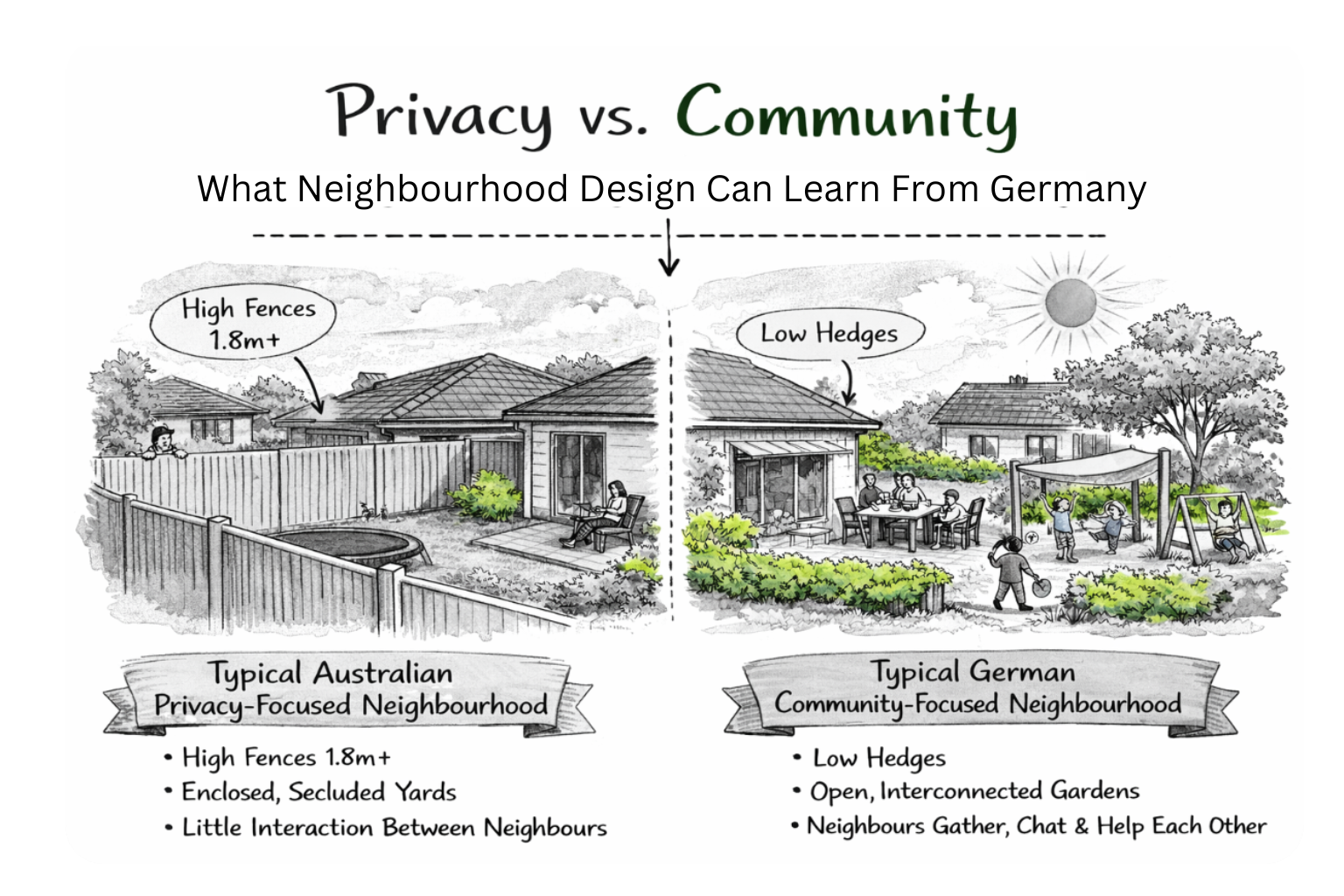
1.8-metre fences around private open space
Screens and frosted glazing on balconies and upper-storey windows
Strict overlooking controls that prioritise separation above all else
The intention is understandable. Privacy matters. But the outcome often isn’t.
We end up with closed-off, inward-looking gardens, particularly on smaller lots. Outdoor spaces become darker, more constrained, and less connected to their surroundings.
And perhaps most importantly: we don’t see our neighbours.
What I Observed in Germany
In Germany, the approach felt almost inverted.
Many neighbourhoods had no fences at all between gardens. Others used low fences, hedges or planting simply to define boundaries rather than enforce separation. The result was an open, green, spacious feeling — even where individual gardens were small.
But the biggest difference wasn’t visual. It was social.
Neighbours saw each other.
They waved.
They talked.
And over time, those small interactions turned into genuine connections.
Children moved freely between gardens. They played outside constantly — not through organised playdates, but through spontaneous, everyday interaction. One trampoline in one garden. A swing set in the next. A picnic somewhere else. Kids roaming safely, confidently, and socially.
Adults gathered too. Instead of each household retreating behind a fence to host their own separate barbecue, neighbours came together. Chairs appeared. Everyone brought something. Conversations flowed. Kids ran around in a pack — ten, maybe fifteen at times, including children from further down the street.
What I witnessed wasn’t curated or programmed.
It was community happening naturally.
Seeing This Pattern Again and Again
What struck me most was that this wasn’t a one-off. We saw it everywhere — different towns, different neighbourhoods, different families.
Strong social connections. Mutual support. Neighbours helping each other with childcare, errands, small jobs around the house. A genuine sense of shared responsibility and belonging.
It was deeply moving.
And if I’m honest, it also made me a little sad.
Reflecting Back Home
Back in Australia, the contrast feels stark.
We previously lived for 13 years in a unit, and while we did know the neighbours on either side — largely because we shared a driveway and parking area — the neighbours at the back were almost invisible. We barely saw them. In one case, I didn’t even know what they looked like, let alone their name.
There were families with children the same age as ours living just metres away. Yet we rarely crossed paths. There was no natural way to connect.
High fences. Solid boundaries. Everyone retreating into their own private bubble.
And the result?
Disconnection.
Loneliness.
A quiet erosion of community — even when people live side by side.
Regenerative Design Is About More Than Buildings
This is where regenerative design becomes so important.
Regenerative design isn’t just about energy, materials or carbon — although those matter enormously. It’s also about social systems, human relationships, and how places help people thrive together.
Design shapes behaviour.
Spatial choices influence how we live, how we meet, how we relate.
When we design neighbourhoods that prioritise separation above all else, we shouldn’t be surprised when people feel isolated. When we remove informal opportunities for interaction, community doesn’t have space to grow.
Regenerative places, by contrast, support:
Visibility without intrusion
Connection without obligation
Shared spaces that feel safe, welcoming and human
They allow relationships to form organically — not because people are forced together, but because design makes interaction easy.
Rethinking What We’re Protecting
I often ask myself:
What are we actually protecting with our obsession with privacy?
What’s the harm if a neighbour sees you having a barbecue, or your kids playing outside?
What’s lost when fences are so high that no connection is possible at all?
Wouldn’t it be nice if children could wander safely through neighbouring gardens again?
If adults could borrow a ladder, share a meal, or simply feel known?
Privacy has value — but so does belonging.
A Question Worth Asking
So I’d genuinely love to hear your thoughts.
How would you feel about living with more open gardens and fewer fences — where seeing your neighbours is part of everyday life, not something to be designed out?
Have you experienced something similar while living or travelling overseas, where community formed more naturally and effortlessly?
Or have you seen examples closer to home where openness led to stronger connections?
I’m increasingly convinced that if we want healthier, more resilient communities, we need to stop treating privacy and connection as opposites — and start designing places that allow space for both.
Because community doesn’t just happen.
We design for it — or we design it out.