
freestanding statement baths
Freestanding Statement Baths: Used Twice a Year, In the Way Every Day
Written by Simone Schenkel
This is Part 8 of the Design Pitfalls in Australian Homes series. Today, the bathroom feature that has dominated Australian floor plans for the last decade: the freestanding bath.
The Image That Sold a Decade of Australian Bathrooms
Picture it. You’ve seen it.
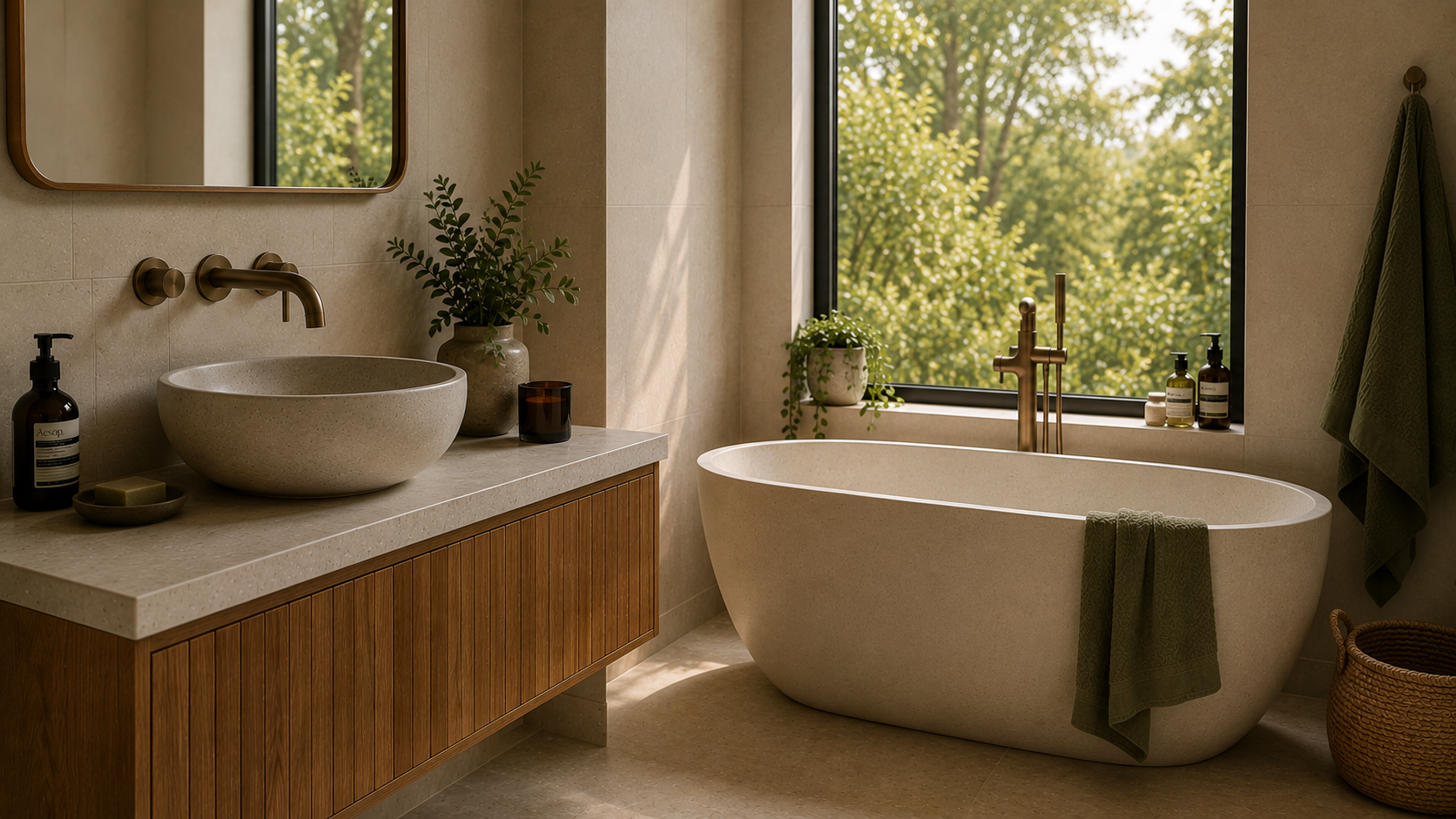
A long, deep, oval freestanding bath. Matte stone or gloss white. Standing alone in a generous bathroom with floor-to-ceiling tiles in some sort of natural stone pattern. Soft afternoon light streaming through a tall window. A tray across the bath with a glass of wine and a candle. Maybe a folded towel.
Every off-the-plan apartment marketing brochure of the 2020s has this image. Every real estate listing fluffs the freestanding bath as a signature feature. Every Pinterest board has fifteen versions of it.
In real life? Most freestanding baths get used a handful of times a year, occupy a huge chunk of the most expensive floor in the house, and create a permanent cleaning chore.
Let’s go through why.
How Often Do You Actually Take a Bath?
Be honest.
If you have kids, you bath them when they’re little — and then they switch to showers somewhere between age 5 and 8. So even an enthusiastic bath user has maybe a 6 to 8 year window of regular bathtub use.
If you don’t have kids, or your kids are older, you might bath yourself occasionally. Once a week if you’re a real bath person. Once a month for most. Once or twice a year for the majority.
Now ask yourself: is once a week (or less) of use enough to justify dedicating 1.5 to 2 square metres of your bathroom floor — plus the surrounding clearance — to a single fixture?
In a typical 8m² bathroom, the bath is eating around 20% of the floor area for what is, for most households, a few hours of use a month.
The Floor Space Cost
Bathrooms in Australian homes are often smaller than they should be. Many new apartments and townhouses are working with ensuite spaces of 4 to 6m², and main bathrooms of 6 to 8m².
A freestanding bath usually wants:
- about 800mm × 1700mm of floor space (the footprint of the bath itself)
- a minimum of 100mm of clearance on each side for cleaning and to avoid a cramped look
- often more, for the dramatic “bath as object in space” effect that justifies the price tag
That’s 2m² minimum, often 2.5–3m² to do it properly.
In a 6m² bathroom, the bath is eating half the floor.
You could use that space for:
- a generously sized walk-in shower (see the shower doors post for why walk-in beats enclosed)
- a much larger vanity with proper bench space (which solves the problem I described in the black basins post)
- a separate WC
- decent built-in storage
- a proper laundry chute or hamper
For most families, any of those would deliver more daily value than a bath that gets used four times a year.
The Cleaning Reality
Freestanding baths are gorgeous. They are also remarkably hard to clean.
Here’s what you’re dealing with:
- The outside of the bath. Because it’s freestanding, the curved exterior is on display from every angle. Every water mark, soap splash and dust film shows. It needs wiping every time the bath is used and dusting regularly even when it’s not.
- Underneath the bath. This is the killer. Most freestanding baths sit on a small footprint with empty floor visible underneath. Dust, hair, lint and the occasional fallen earring collect down there. You can’t easily mop under it. You can’t really reach in.
- Around the base. Where the bath meets the floor, there’s usually a small seal or gap. Water that drips down the side pools there. It’s awkward to wipe and tends to stay damp.
- The plumbing. Modern freestanding baths often have visible floor-mounted spouts and mixers. They look great. They are another chrome (or matte black) surface to wipe down, and the floor flange where they emerge from the floor is its own little dirt collector.
Compare with a built-in or inset bath: tiled in on three sides, sealed properly, easy to wipe. Less photogenic, much easier to live with.
The Filling Time Problem
A freestanding bath is usually big. Like, really big — 1700 to 1800mm long, sometimes 750–800mm deep. That’s a beautiful bath.
It’s also a lot of hot water.
Filling a deep freestanding bath uses 200 to 400 litres. In the middle of an Australian summer or during a drought, that’s an uncomfortable amount of water for a single soak. In winter, that’s a lot of energy to heat. If you have a small hot water system, you might not have enough hot water in one go to fill it.
The result: people fill it less than they thought they would, and the bath sits empty most of the time.
When a Bath Genuinely Earns Its Place
I’m not anti-bath. Baths can be wonderful. But the question is what kind and where.
A bath earns its place if:
- you have young kids and you’re going to use it weekly
- you are a genuine bath person and will use it most weeks for the next decade
- your bathroom is large enough that the bath doesn’t compromise the rest of the room
- the bath provides essential function — for example, a soaking bath for someone with chronic pain or muscle conditions
In those cases, here are better ways to specify it:
- An inset bath, tiled in on three sides. Far easier to clean, less floor space, much easier to detail well. Looks beautiful when done with quality tiles and a good edge detail.
- A bath set against a wall or in a corner, with one or two sides exposed, rather than fully floating in the middle of the room.
- A smaller, well-proportioned bath rather than the deepest, longest one in the showroom.
The “object in space” freestanding bath is a styling choice. It’s not the only — or best — way to give a bathroom a beautiful bath.
A Quick Word on Resale
Real estate agents love freestanding baths because they show well in listing photos. There is some resale argument there.
But there is also a generation of buyers — particularly younger buyers, families with older kids, and downsizers — who increasingly value a great walk-in shower, a properly sized vanity and a well-laid-out bathroom over a single statement bath they won’t use.
The market is shifting. Don’t assume the freestanding bath is an automatic resale win.
My Take
If you’re a serious bath user, build a bath you’ll actually use, and detail it so it’s easy to clean. If you’re not, save the floor space, save the money, and put a slightly more generous bathroom together with a great shower and a great vanity. That’s the bathroom you’ll enjoy 365 days a year.
The freestanding bath is the kitchen island sink of the bathroom world. Beautiful in renders. Rarely worth it in real life.
Have questions about your future home? Book a free 30-minute consultation with our design team.
Up Next
Next in the series: powder rooms without a hand wash basin — please, no.
This is Part 8 of the Design Pitfalls in Australian Homes series. Browse the full series to see all the design choices that look great in theory and fall over in real life.
freestanding statement baths freestanding statement baths freestanding statement baths freestanding statement baths freestanding statement baths freestanding statement baths freestanding statement baths freestanding statement baths freestanding statement baths