
passive house certification Australia
What’s Actually Involved in Getting a Passive House Certified?
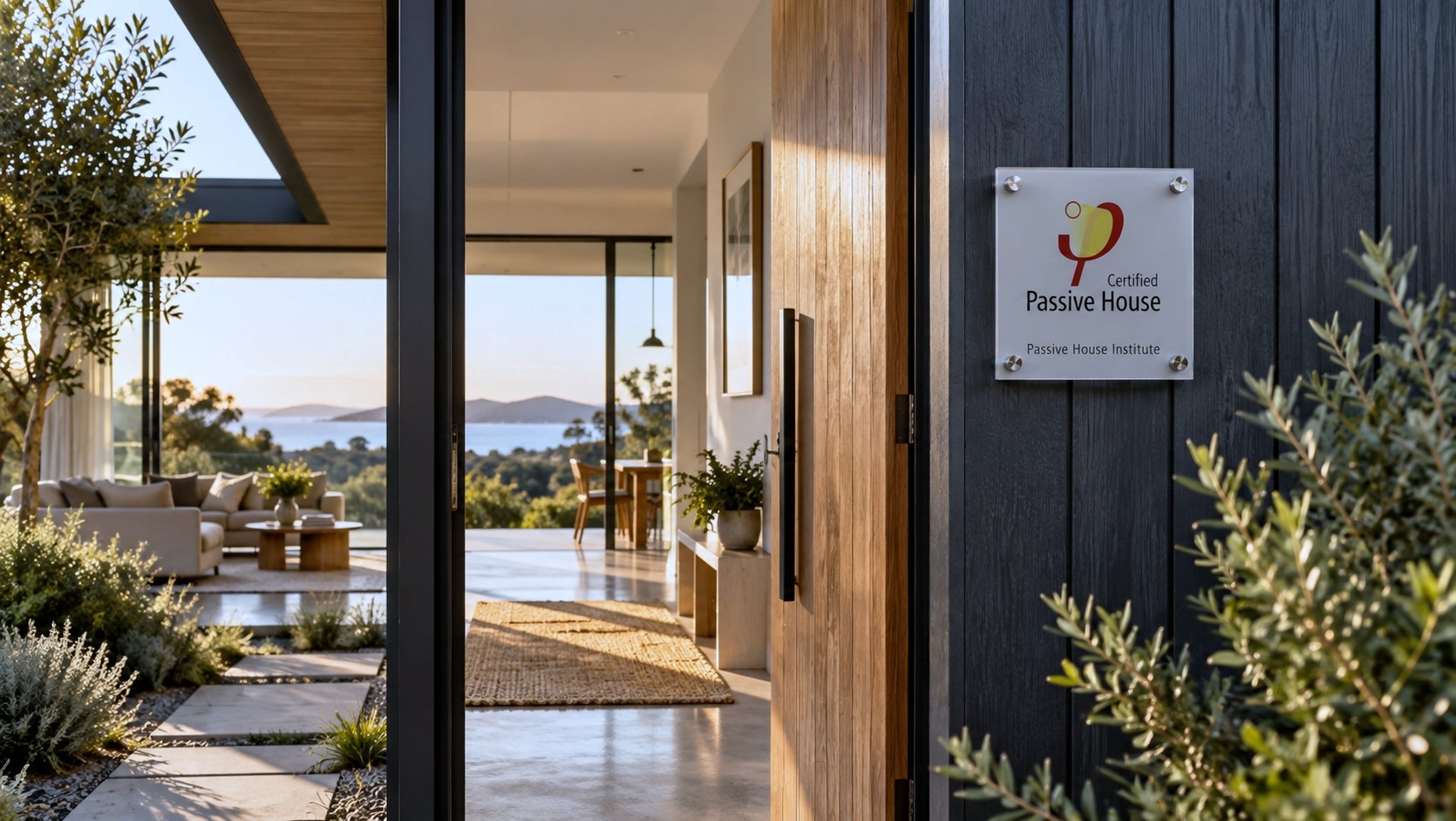
“Certified Passive House” gets used a lot, and it’s easy to assume it’s a marketing badge — something a builder can claim because they used good insulation and nice windows. It isn’t. Certification is a genuinely rigorous, independently verified process, and understanding what’s behind it is one of the best ways to protect yourself as a client.
If you’re researching passive house certification australia, it’s important to understand that certification is about much more than a label. It involves defined performance targets, detailed modelling, documentation, testing and independent verification.
Here’s what Passive House certification in Australia actually involves, what the requirements are, and why it matters even if you decide not to formally certify.
Certification is about proof, not promises
The whole point of Passive House certification is that the building has to demonstrably perform — not just be designed with good intentions. It’s assessed against hard, measurable targets and signed off by an independent certifier who wasn’t involved in designing or building it.
That independence is the safeguard. It’s the difference between “we built it to a high standard, trust us” and “an independent third party has verified it meets the standard.”
This is at the heart of passive house certification australia: the performance of the finished building needs to be supported by evidence rather than simply claimed by the builder or designer.
That’s also why we’re so wary of the phrase “built to Passive House principles.” Principles are optional and unverified. Certification is neither.
For clients comparing different approaches to passive house certification australia, this distinction is one of the most important things to understand. A home can incorporate Passive House principles without being certified, but certification provides an independent layer of accountability.
The core requirements
To be certified, a home has to hit a defined set of performance criteria. The headline numbers for the standard “Classic” level:
-
Heating (and cooling) demand: no more than about 15 kWh/m² per year — a tiny fraction of a typical home’s energy use for keeping comfortable.
-
Airtightness: 0.6 air changes per hour at 50 pascals (written as n50 ≤ 0.6), confirmed by a blower-door test. This is a genuinely demanding target and one of the hardest to fake.
-
Primary energy demand: a cap on the total renewable primary energy the home uses.
-
Comfort criteria: limits on overheating and on cold surfaces, so the home is comfortable year-round, not just energy-efficient on paper.
These measurable requirements are what make passive house certification australia different from simply marketing a home as “high performance.”
There are also higher tiers — Passive House Plus and Premium — which add on-site renewable energy generation, for homes aiming to produce as well as save. And for renovations, there’s a dedicated standard called EnerPHit, which recognises that an existing building can’t always hit new-build targets but can still reach an exceptional level of performance.
Understanding these different certification levels is an important part of navigating passive house certification australia, particularly if you’re comparing a new build with a renovation or looking at different energy-performance goals.
How the process actually runs
Certification isn’t a single inspection at the end. It runs alongside the whole project:
-
Design and modelling. Everything is modelled in advance using PHPP, the Passive House Planning Package — the software that calculates exactly how the building will perform before a brick is laid. This is where the real engineering happens, and why we push so hard to run these calculations early in the design.
-
Documentation. The certifier reviews the design, the calculations, the product data sheets (windows, ventilation, insulation), and the construction details — particularly the junctions where thermal bridges hide.
-
Construction verification. Evidence is gathered on site as it’s built: photos of insulation and airtightness layers before they’re covered up, product confirmations, and the all-important blower-door test to prove the airtightness target is actually met.
-
Independent sign-off. The certifier checks it all against the standard and issues certification only if the evidence stacks up.
This process is central to passive house certification australia because the building is being assessed throughout its development, rather than relying on a final inspection to establish whether the intended performance was achieved.
That sequence is the point. You can’t paper over a gap at the end — the proof has to be built in along the way.
What about the builder’s and designer’s credentials?
Certifying the building is one thing; the people matter too. A couple of things worth checking when you’re choosing who to work with:
-
Certified Passive House Designer / Consultant — a qualification held by individuals who’ve been trained and examined in Passive House design. It tells you the person understands the building physics, not just the buzzwords.
-
Certified Passive House Tradesperson — a similar credential for builders and trades.
-
Track record — ask to see completed projects, and ideally their blower-door results. Real numbers from finished homes tell you more than any brochure.
When researching passive house certification australia, don’t just ask whether a company “does Passive House.” Look at who is designing the project, who is building it, who is certifying it and what evidence they can provide from completed projects.
Asking “are you a Certified Passive House Designer, and can I see your blower-door results?” is a completely fair question — and the answer is revealing.
Do you have to certify?
No — and this is worth being honest about. Formal certification adds cost and administrative effort, and some clients choose to build to the full standard without paying for the certificate itself. That can be a legitimate choice if the same rigour, modelling and verification (especially the blower-door test) are applied.
For some clients considering passive house certification australia, the decision ultimately comes down to whether the additional cost and administration of formal certification provide enough value for their project.
What we’d never recommend is skipping the verification. The certificate is optional; the proof that the building performs is not.
Certification is simply the most robust way to guarantee that proof — an independent party staking their name on it.
This is the key distinction to keep in mind when comparing passive house certification australia with simply building “to Passive House principles.” The certificate itself may be optional, but the process of designing carefully, modelling performance and testing the finished building should not be.
The short version
Passive house certification australia means a home has been independently verified to meet strict, measurable targets — roughly 15 kWh/m²/year for heating and cooling, 0.6 air changes per hour confirmed by a blower-door test, and defined comfort limits — with the evidence gathered throughout design and construction, not just claimed at the end.
Whether or not you formally certify, that rigour and verification are what separate a genuine high-performance home from one that just looks the part.
If you’d like to understand which path makes sense for your project — full certification, or the standard without the certificate — let’s talk it through. We’ll give you an honest view of the trade-offs. You can also book a free 30 -minute consultation with us!
This article explains the certification process in general terms. Requirements and levels can change and vary by certifier — we’d be glad to walk through the current specifics for your project.