
vessel and sit-on-top basins
Vessel and Sit-On-Top Basins: Are They the Right Choice for Your Bathroom?
Written by Simone Schenkel
This is Part 6 of the Design Pitfalls in Australian Homes series. The previous post looked at black basins and dark fixtures. Today, a basin style I have a soft spot for — and which I have in my own home.
A Confession Before We Start
I genuinely like vessel and sit-on-top basins. I have them in my own house. They are beautiful objects; they bring a sculptural quality to a bathroom that recessed basins simply can’t, and they’re a lovely sight first thing in the morning.
So this is not an “avoid this” post. It’s a “go in with your eyes open” post.
Because in the years I’ve spent looking at homes — both as a designer and lately as a renter — I’ve seen plenty of vessel basins specified by people who had no idea what they were signing up for. There are three things in particular that nobody mentions in the showroom, and that you really should know before you choose one.
Plan for them, and you’ll love your vessel basin for decades. Skip the planning, and you’ll spend the next ten years frustrated.
What’s a Vessel Basin?
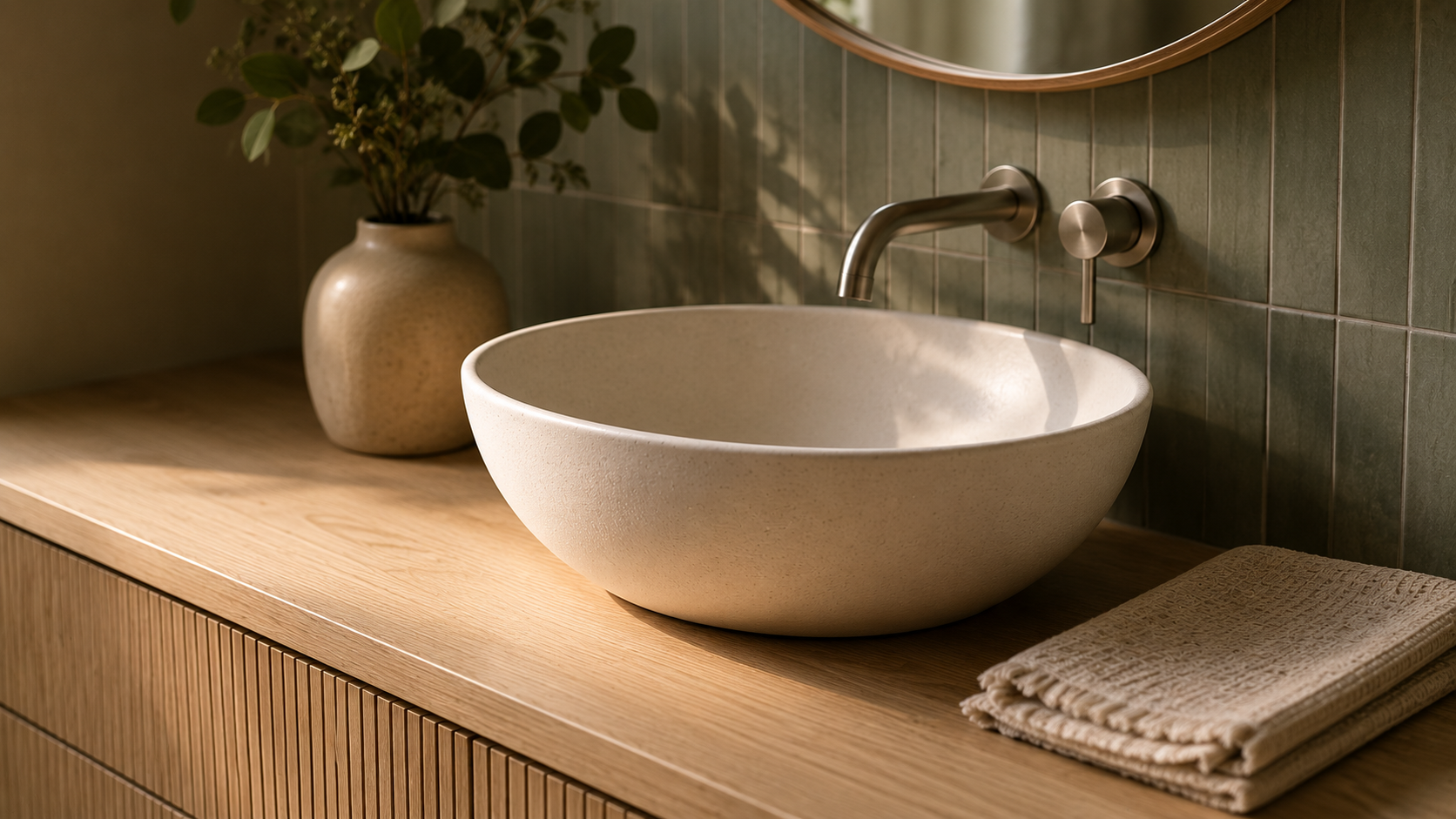
For clarity: a vessel basin (sometimes called a sit-on-top or above-counter basin) sits on top of the vanity bench rather than being recessed into it. It looks like a ceramic, stone or glass bowl perched on a slab of timber or stone.
The design intent is sculptural. The basin is a feature. The vanity is the plinth. The whole thing reads like an object on display.
That’s exactly why I love them. And that’s also exactly where the pitfalls hide.
Pitfall #1: The Vanity Height Has to Be Adjusted
This is the one I want to lead with, because it’s the most important and the most frequently missed.
A standard Australian vanity bench is around 850mm high. With a recessed basin, the rim of the basin sits flush with the bench at that same 850mm. That’s a comfortable working height for an average adult.
A vessel basin sits on top of the bench. Depending on the depth of the bowl, that adds another 100–150mm. If you don’t adjust anything, your basin rim is suddenly at 950–1000mm — meaningfully higher than standard.
That’s:
- too high for most kids, including teenagers, without a stool
- awkward for shorter adults, who have to reach up to wash hands or splash water on their face
- uncomfortable for tasks where you naturally lean in: brushing teeth, washing your face, rinsing your hair, anything that involves bending toward the basin
The fix is simple, but it has to be planned for: specify a lower vanity bench underneath your vessel basin. Drop the bench to 700–750mm, and once the basin sits on top, you’re back to a comfortable 850–900mm rim height.
Most stock joinery is built to a standard 850mm. If you order vessel basins without specifying a lower bench, the joiner will give you what they always give you, and the result will be a basin that’s too tall for everyone in the house.
This is the single most important thing to get right. Talk to your designer or joiner about it before any cabinetry is built.
Pitfall #2: The Silicone Seam Needs to Be on Your Maintenance List
This is the one most people genuinely don’t know about, and it’s worth understanding before you commit.
A vessel basin sits on top of the bench. To stop water leaking through the gap where the basin meets the bench, the installer runs a bead of silicone all the way around the base of the basin.
That silicone bead is in a tough spot. It’s:
- shaded by the basin (so it dries slowly)
- splashed regularly during hand washing
- in the path of soap residue, toothpaste and skin cells that run down the outside of the bowl
- in a humid bathroom environment
Over time, that silicone bead degrades. It collects soap residue and moisture. Eventually it discolours — going from clean white or clear to a grey-pink tinge — and that’s the silicone telling you it’s time for some attention.
There are two things you need to know:
One — daily habit matters more than people think. A quick wipe around the base of the basin after you wash, especially if you’ve splashed soap or toothpaste, makes an enormous difference to how long that silicone stays clean. It’s a 5-second habit. Build it in and the silicone lasts much longer.
Two — plan for a silicone refresh every few years. No silicone bead lasts forever in a bathroom. Every 3–5 years (sometimes sooner in a humid bathroom or harder-water area), the silicone around a vessel basin will need to be cut out and re-applied. This is a normal maintenance task, not a sign of a bad install.
This matters because if you ignore it for too long, water starts to find its way through degraded silicone into the join between the basin and the bench. Over years, that can damage timber benchtops, stain stone, and in the worst case cause the bench to swell or delaminate. Catching it early — checking the silicone every six months or so, and re-doing it when it starts to look tired — protects your vanity and your benchtop investment.
A reseal job is straightforward and not expensive (a couple of hundred dollars if you get a tradie in, less if you DIY with a steady hand). It just needs to be on your list.
Most people who buy vessel basins are never told this. Now you know.
Pitfall #3: The Mixer Will Cost a Bit More
Vessel basins need either a tall vessel-style mixer (a taller-than-standard tap with enough height to clear the bowl rim and reach into the basin) or a wall-mounted mixer (where the spout and lever sit on the wall behind the basin).
This isn’t really a problem — it just means a slightly different shopping list, and a small extra cost compared to a standard hob mixer.
- A vessel-style tall mixer typically costs $100–$300 more than a standard hob mixer in the same range.
- A wall-mounted mixer needs the plumbing rough-in to be in the wall behind the basin, which adds a bit to the plumbing labour and locks in that position. Wall mixers can also leak behind the wall over time, so quality matters more here than for a hob-mounted equivalent.
Either way, neither option is a deal-breaker. Just budget for the slightly higher mixer cost and make the decision early so the plumbing rough-in is right.
If you’re going wall-mounted, my preference is to spend a bit more on a good-quality mixer and a careful installer. The convenience and cleanability of having nothing on the bench is genuinely lovely.
The Splash Question
While we’re here, a quick mention. Tall vessel basins, especially steep-sided ones, can splash more than recessed basins. Water hits the bottom of the bowl and bounces.
Two things make this a non-issue in practice:
- Choose a basin with a wider, shallower bowl shape if splash is a concern. Steep cylindrical vessels splash the most; gently curved wider bowls splash much less.
- Match the mixer height and spout position to the basin. A spout that’s too high and pointed straight down into the centre of the bowl is a recipe for splash. A spout that angles slightly forward into the bowl, at a sensible height, contains the water.
A bit of thought at specification time and splash is rarely a real-world problem.
A Quick Note on Semi-Recessed Basins
Semi-recessed basins sit partly below the bench and partly above. They’re a softer aesthetic statement than a full vessel and still give some of that sculptural feel.
They have the same silicone seam to watch (just a shorter one), and the height question is less acute because more of the bowl sits below the bench. If you love the vessel look but are nervous about the height issue in a family bathroom, semi-recessed is a great middle ground.
My Take
Vessel basins are beautiful. I have them in my own home, and I have no regrets. They turn a vanity into a piece of joinery worth looking at, and they bring a real sense of considered design to a bathroom that recessed basins can’t quite match.
But they come with three commitments most people aren’t told about:
- Adjust the vanity height so the basin rim ends up at a comfortable working height for everyone in the household.
- Build a quick wipe around the base into your routine to keep the silicone seam clean and dry, and check it every six months.
- Plan a silicone reseal every 3–5 years as a normal maintenance item, before it lets water through and damages the bench.
Do all three and you’ll love your vessel basin for the long haul. The pitfall isn’t the basin — it’s choosing one without knowing what comes with it.
Planning a new home or renovation? Book a free 30-minute design consultation with our team to discuss your ideas and make informed design decisions from the start.
Up Next
Next in the series: shower doors — the cleaning nightmare nobody warns you about.
This is Part 6 of the Design Pitfalls in Australian Homes series. Browse the full series to see all the design choices that look great in theory and fall over in real life.
vessel and sit-on-top basins vessel and sit-on-top basins vessel and sit-on-top basins vessel and sit-on-top basins vessel and sit-on-top basins vessel and sit-on-top basins vessel and sit-on-top basins vessel and sit-on-top basins vessel and sit-on-top basins